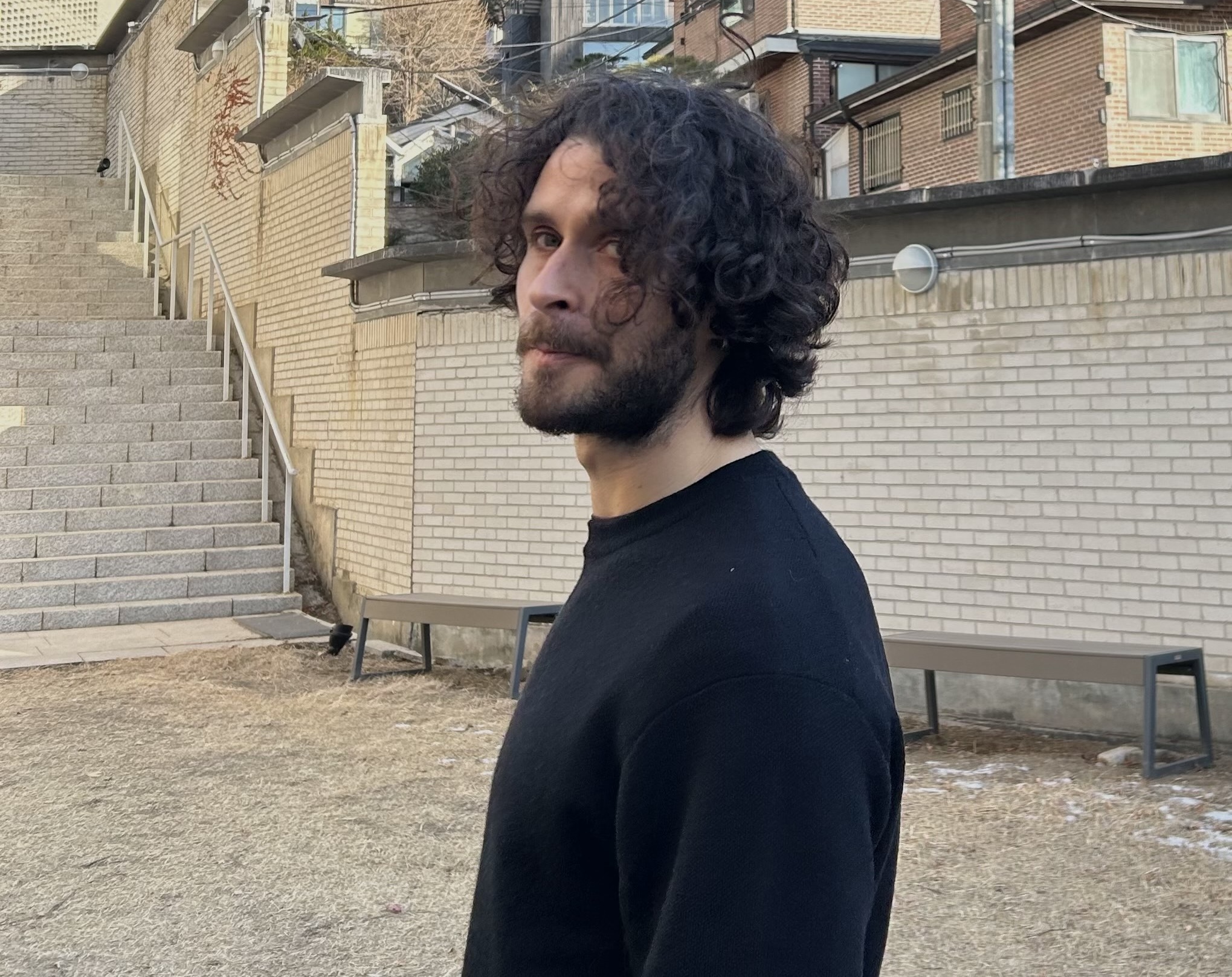
Theo Guenais, S.M. '20
For artificial intelligence to integrate safely into society, we have to be able to trust it. We need to understand how large language models like ChatGPT or other AI tools process data, and we need to be confident that the results those systems provide are as accurate as if they were given by a person with technical expertise.
“Humans are sometimes very good at making the right decision, sometimes very bad,” said Theo Guenais, S.M. ‘20. “But we have a competitive advantage, and those algorithms need more work.”
Guenais has been studying how to improve AI ever since he was part of the master’s in data science program at the Harvard John A. Paulson School of Engineering and Applied Sciences (SEAS). After finishing his degree, Guenais continued doing AI research in Quebec and as part of the Data to Actionable Knowledge (DtAK) Lab at SEAS. He now works at Symbolica AI, a research lab founded in 2022 to develop the next generation of AI models.
“We're trying to build systems that are verifiable, robust, and able to learn different desired behaviors,” Guenais said. “That's one of the themes that I've always been very interested in: the robust and verifiable deployment of those algorithms.”
Guenais came to SEAS after finishing both undergraduate and master’s degrees in applied math in his home country of France. The data science program allowed him to dive deep into AI research, introducing him to professors like Finale Doshi-Velez, Herchel Smith Professor of Computer Science and head of the DtAK Lab, and Weiwei Pan, Assistant Director for Graduate Studies in Data Science.
“Harvard had been a dream for a very long time because of the name of the institution and the faculty,” he said. “The master’s in data science is an exceptional program and perfect opportunity because it was really aligned with my skills and the things that I wanted to develop. It gave me the skills for the rest of my career, it gave me credentials, and it gave me the ability to find people who are truly exceptional.”
Prior to Harvard, Guenais also worked as a deep learning research intern for the Agency for Science, Technology and Research in Singapore. After graduating and finishing a summer internship at the Quebec Artificial Intelligence Institute, he returned to DtAK to work on a project quantifying the uncertainty of AI algorithmic responses.
“There are a few things that make algorithms prone to hallucination, prone to being overconfident, which therefore limits the way we can just deploy and have those algorithms in practice,” he said. “The research that we did was really about developing techniques so that we can quantify the uncertainty of those algorithms. We want the algorithm’s decisions to not be made in an overconfident way, but instead with the right level of confidence. We need to be able to determine whether the algorithm is uncertain because the data itself is messy or noisy, or because it’s just too far from anything that we've seen before.”
Guenais left SEAS in 2021 to work at Tesla before joining Symbolica at the start of 2026. As a research engineer, he now plays a key role in advancing the company’s mission to develop more reliable AI algorithms that can process data using new levels of logic and reasoning.
“The mission was aligned with what I did at Harvard and what I've been trying to do for most of my career,” he said. “This was my way to go to the next level of learning and taking more responsibilities, being able to really shape the vision of the company and have my directives and ideas implemented.”
Symbolica’s current product is Agentica, an open-source platform for spawning AI agents. But Guenais spends most of his time on the research side, helping lead Symbolica’s engineering team towards its future offerings.
“Our ambitions outpace what's currently buildable, so right now we’re research-first,” he said. “We have some projects where my role as a more senior engineer scientist is more about developing the experimental design and protocols so that we can have the right experiments, have the right directions, and then reallocate and redirect ourselves depending on those results. And because we're still small, I still actually write a lot of code and run some of those experiments myself. It’s kind of a typical scientific lab workflow where we collect data, we build hypotheses and try to test them.”
All the work Guenais has done has come together in his current position. Studying data science taught him how to run and analyze experimental protocols, while Symbolica expanded his technical skillset. As his work continues, he knows his background will enable him to help produce the next generation of AI algorithms.
“If I had to really take one thing out of Harvard beyond the skillset, it would be that ability to develop yourself intellectually,” he said. “There’s an intellectual wealth here, so many people, so many faculty, so many conferences, and you have to live it to really understand how it is. All those skills that I developed in my courses are definitely now being used, because building the new wave of AI is the most complex thing I've ever faced.”
Press Contact
Matt Goisman | mgoisman@g.harvard.edu