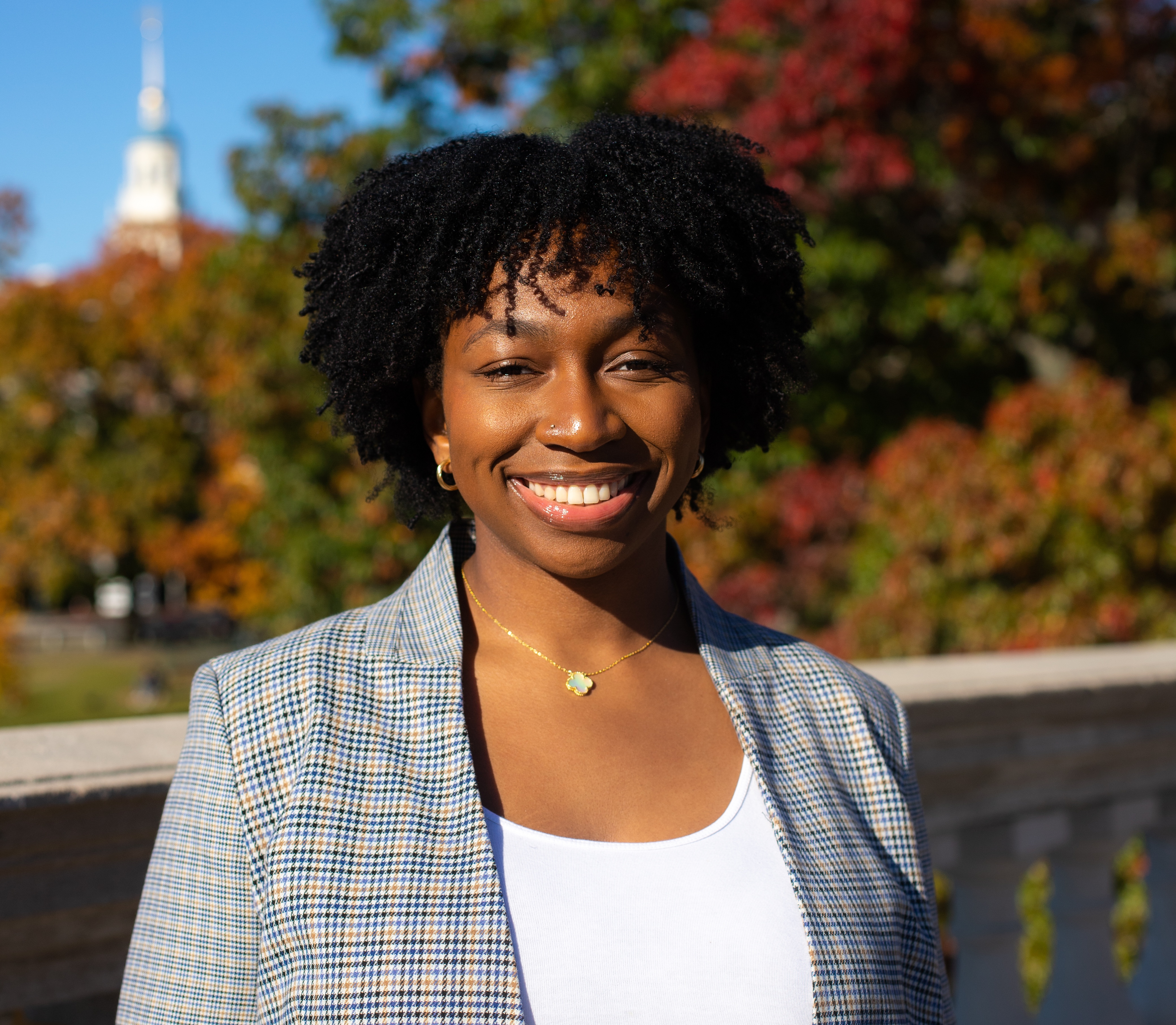
Tiffany Kalu, S.B. '24
Sometimes it just takes the right internship. Tiffany Kalu, S.B. ‘24, spent the summer before her senior year as a water infrastructure and climate adaptation intern at the Arlington, Virginia office of Ramboll, an international sustainable engineering consultancy. She worked on projects ranging from airport water infrastructure to stormwater pollution prevention at manufacturing sites, gaining a far broader understanding of how organizations and cities handle one of our most fundamental resources.
“It was a really good experience, seeing all the different projects that are in water and all the different lanes you can go into,” she said. “I thought it was a really collaborative environment, and as an intern I was included in a lot of different types of projects. There were people from a lot of different backgrounds that I could learn from.”
Kalu so enjoyed the work that she kept in touch with them throughout her final year as an environmental science and engineering concentrator at the Harvard John A. Paulson School of Engineering and Applied Sciences (SEAS). By the beginning of her last semester, she accepted a full-time position as a water resources staff engineer, and she’s been there ever since.
“There's a lot that can be done in this space, and it's really important because water is a very basic and important human need.” she said. “This is definitely a career I plan to continue in. I'm still figuring out what I like and what interests me, given the broadness of the water industry.”
Growing up in DeSoto, Texas, just south of Dallas, Kalu’s path to SEAS began with summer programs in which she studied chemical engineering and the feasibility of second-life batteries, which are repurposed electric vehicle batteries whose charging capacity has dropped too much for automotive use. Once she got to Harvard, she took introductory courses in several engineering disciplines, but environmental science and engineering won out. Her academic career culminated in a senior capstone project, “Utilizing Radiative Cooling Technology for Sustainable Water Harvesting.”
“Environmental engineering tied into my desire to have a positive impact on the environment and on society while using my math and science skills,” she said.
When not in her classroom, Kalu focused on building the SEAS community. She did sustainability research for the Social Equity Working Group at Harvard’s Office for Sustainability, worked as a peer advising fellow, and was a board member of the Harvard Society of Black Scientists and Engineers (HSBSE).
“One of the coolest parts of being at Harvard was creating and fostering a community, especially for folks who might not have come from a background of people who went to Harvard before them,” she said. “I wanted to help create a space where all are welcome, and where people felt represented.”
Kalu’s time in HSBSE proved especially valuable to her future career, as she first discovered Ramboll on a trip to the National Society of Black Engineers Convention during her sophomore year. While she’d already secured a research fellowship at Columbia University for that summer, she made sure to contact Ramboll during her junior year.
“I knew I wanted to do some type of consulting internship, so I started thinking of different environmental consulting companies,” she said. “In my junior spring I studied abroad at University College London. I took a class on green infrastructure, and that was a really good experience that I wanted to integrate into my engineering work. That led me to the water infrastructure and climate adaptation internship at Ramboll.”
Kalu hopes to build a long-lasting career in water infrastructure and management, and is currently working towards her professional engineering license. Her current work includes the designing and long-term planning of water infrastructure for local water utilities in the Arlington-Washington, D.C. area. Through it all, she’s found that communication with stakeholders is essential to making her designs work.
“One of the biggest things now is community outreach,” she said. “I think sometimes that tends to get a bit overlooked in infrastructure planning, and within our projects at Ramboll we definitely try to keep that at the forefront. It's really important to let residents know what's going on in their communities, especially with projects that may likely impact their day-to-day lives both in the short and long term. We want to involve stakeholders early in the design process and use our expertise to create the most sustainable solution.”
Press Contact
Matt Goisman | mgoisman@g.harvard.edu