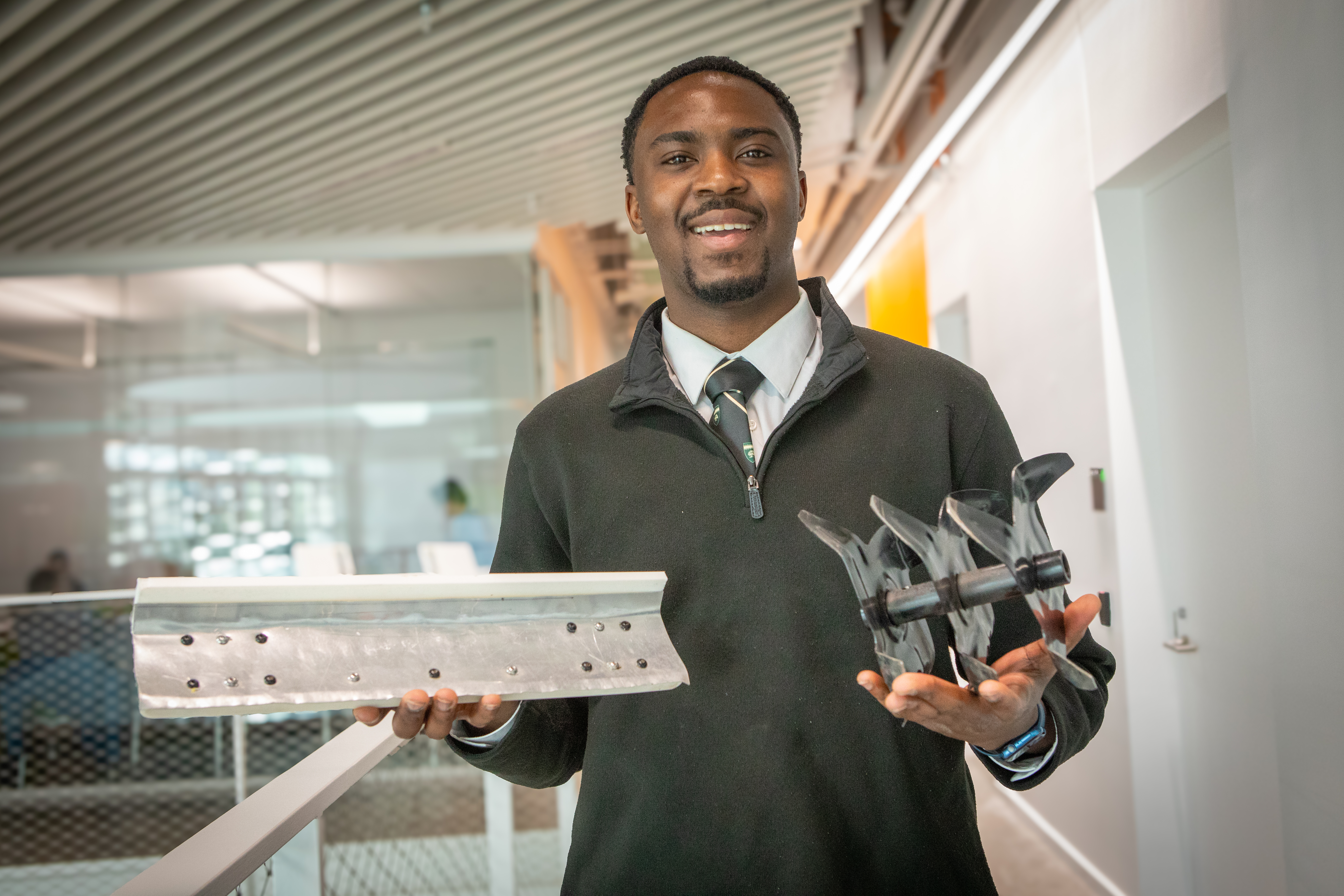
Tolu Ademola, S.B. '26, in mechanical engineering (Eliza Grinnell/SEAS)
After a year at the Altoona campus of Pennsylvania State University, Tolu Ademola wanted a change. He wanted to go somewhere that felt like a true university campus. And while he knew he wanted to study engineering, he wanted a school that would encourage him to take humanities as well.
“I wanted to find a way to combine global development, engineering and sustainability,” Ademola said. “I was thinking of doing a government secondary, and had taken political sciences classes during my freshman year.”
The Harvard John A. Paulson School of Engineering and Applied Sciences (SEAS) offered everything Ademola wanted. After transferring here, Ademola pursued an S.B. in mechanical engineering, while also exploring how engineering can intersect with global impact. After his sophomore year, Ademola joined the Global Initiative program at Harvard Business School, helping put together case studies on businesses in Africa.
Ademola was inspired by farmers in sub-Saharan Africa for his senior capstone project. He designed a robotic end effector – essentially the “hand” at the end of a robotic arm that interacts with the environment – that could be mounted on a small unmanned ground vehicle. That end effector could then be used to replicate the labor-intensive traditional methods the farmers use to make their soil more suitable for agriculture.
“With a lot of these regions, water can't really penetrate the soil, can't really imbue the soil with nutrients again, because it's just so hard and compacted,” he said. “These are regions where they might only get rainfall a couple weeks in the year during the rain season, and if that water can never actually enter the soil, it can never actually replenish itself. The goal of this thesis was to show that while there are these traditional techniques which have been proven effective, they're very arduous, very long and very difficult. I wanted to automate that process, make it remotely operable and just less physically demanding.”
Ademola, who is of Nigerian descent, grew up in the United Kingdom until his family moved to Washington, D.C. for his final two years of high school. Along the way, he developed interests in math, physics, and design.
“I didn't want to be a lawyer, because I felt like I was not the fastest reader,” he said, laughing. “I didn't want to be a doctor, because I didn’t have a great biology experience in high school. So I think engineering just made the most sense. I really liked the design and creativity aspect alongside the math and science.”
That love for design and creativity made “PS70: Introduction to Digital Fabrication” the perfect class for Ademola. It was how he met Nathan Melenbrink, Lecturer on Physics and Fabrication Lab Supervisor, who became his capstone project advisor, and Ademola eventually became a course assistant as well.
“Essentially all you do is prototype,” he said. “You learn a new type of prototype and every week: one week is 3D printing, another week is CNC milling, or microcontroller programming. I just really love that hands-on style of engineering.”
At SEAS, Ademola quickly sought community through student clubs, including the SEAS-affiliated Harvard Society of Black Scientists and Engineers (HSBSE), where he served on the board; the Harvard Undergraduate Sports Lab (HUSL), where he served as Head of Digital Content and now Vice President of Marketing; and the Harvard Consulting on Business and the Environment. During his time here he also interned at venture capital firms such as Collide Capital. He spent last summer as a product management intern at Axon, working on a GPS tracker that could be launched onto a moving vehicle, thus removing the need for a dangerous car chase in which one vehicle pursues the other at high speeds.
“I was working on the firmware team, which was very different from everything I've done before,” he said. “I remember the first few weeks of the internship, I was sitting in every standup meeting with the engineers and thinking I did not know what was being said. But the immersion and being absorbed in that environment was a really cool experience.”
After graduating, Ademola plans to work at the intersection of engineering and finance. Wherever he winds up, Ademola knows the mentality he developed at SEAS will help him succeed.
“I think every engineer can kind of attest to this: You sit down, it’s 11:32 PM, you have a problem set due in 30 minutes, and you're wondering why you picked this major,” he said. “But then you think about how while you've never been exposed to this thing before, you already have a mental framework and instinct to break down problems in a way that is logical. The biggest thing I've learned here is knowing what are good questions to ask in all these different avenues to explore.”
Press Contact
Matt Goisman | mgoisman@g.harvard.edu