News
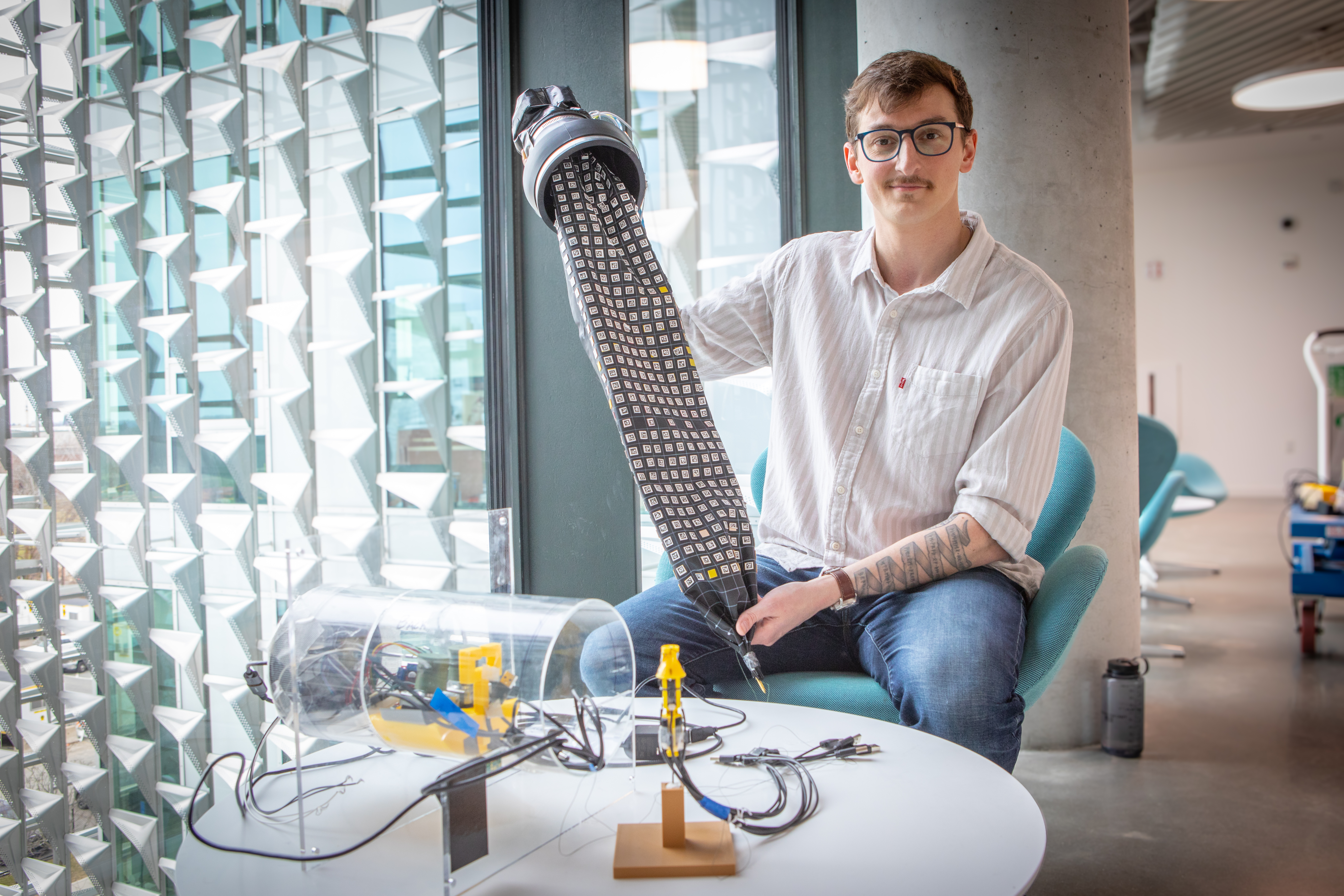
For his senior capstone project, Viktor Bokisch designed a method for vine robots to sense their own orientation during space exploration (Eliza Grinnell/SEAS)
Engineering Design Projects (ES 100), the capstone course at the Harvard John A. Paulson School of Engineering and Applied Sciences (SEAS), challenges seniors to engineer a creative solution to a real-world problem.
Planetary Scout: A Bio-Inspired, Soft, Growing Robotic Platform for Mapping Confined, Irregular Planetary Spaces
Viktor Bokisch, S.B. ‘26, Bioengineering
Advisor: Nelson Badillo
• Please give a brief summary of your project.
Vine robots are soft-robotic platforms that don't move in their environments – instead they "grow" into them like vines. They do this by using internal pressure to force more soft material like nylon to come out from the tip, which is called eversion. An apt analogy would be like rolling up a sock and then rolling it onto your foot – more material is added to the length of the system rather than the system itself moving. These robots are currently being studied for their uses in space exploration, specifically mapping cavities and crevices, but their soft nature means we need special sensors to detect their shapes once they've grown. The ability to sense one’s own position and location within an environment is called proprioception. My project consisted of developing a new way to perform this proprioception. I did so by designing these small, moving camera arrays that crawl along the inside of the vine after it's grown. They image the inside of the vine robot’s body, and then the system models the robot’s shape from that.
• What real-world challenge does your project address?
This kind of sensing in vine robots, proprioception, is not new to the field itself, but prior implementations weren't suited for space travel due to a variety of constraints. The implications of this system are doubly beneficial to the vine-robot community, as it's also one of the first generations of these proprioceptive sensor solutions for these robots. The field is very novel, and this sensing approach stands to become a common solution due to the ease of replication and implementation.
• How did you come up with this idea for your final project?
This idea came from working with Nelson Badillo, a Ph.D. student in Prof. Conor Walsh’s Harvard Biodesign Lab who is researching vine robot implementations for space exploration. Capabilities in these regards could be improved upon with a viable proprioceptive sensing strategy.
• What was the timeline of your project?
I started building as early as possible so I blended designing prototyping and ideating as much as possible.
• What part of the project proved the most challenging?
Surprisingly, getting small things to work that were largely unrelated to the core project goal. I had to build a full working vine robot prototype before I could even start testing my system.
• What part of the project did you enjoy the most?
Once the vine itself was functional, designing and iterating the actual computer vision portion was by far the most fun.
• What did you learn, or skills did you gain, through this project?
I learned a lot about system integration, getting many different components to talk to each other. Computer-vision itself was an entirely new world to me, so I had to learn how to implement and design this kind of system completely from scratch.
Topics: Academics, Bioengineering, Robotics
Cutting-edge science delivered direct to your inbox.
Join the Harvard SEAS mailing list.
Press Contact
Matt Goisman | mgoisman@g.harvard.edu