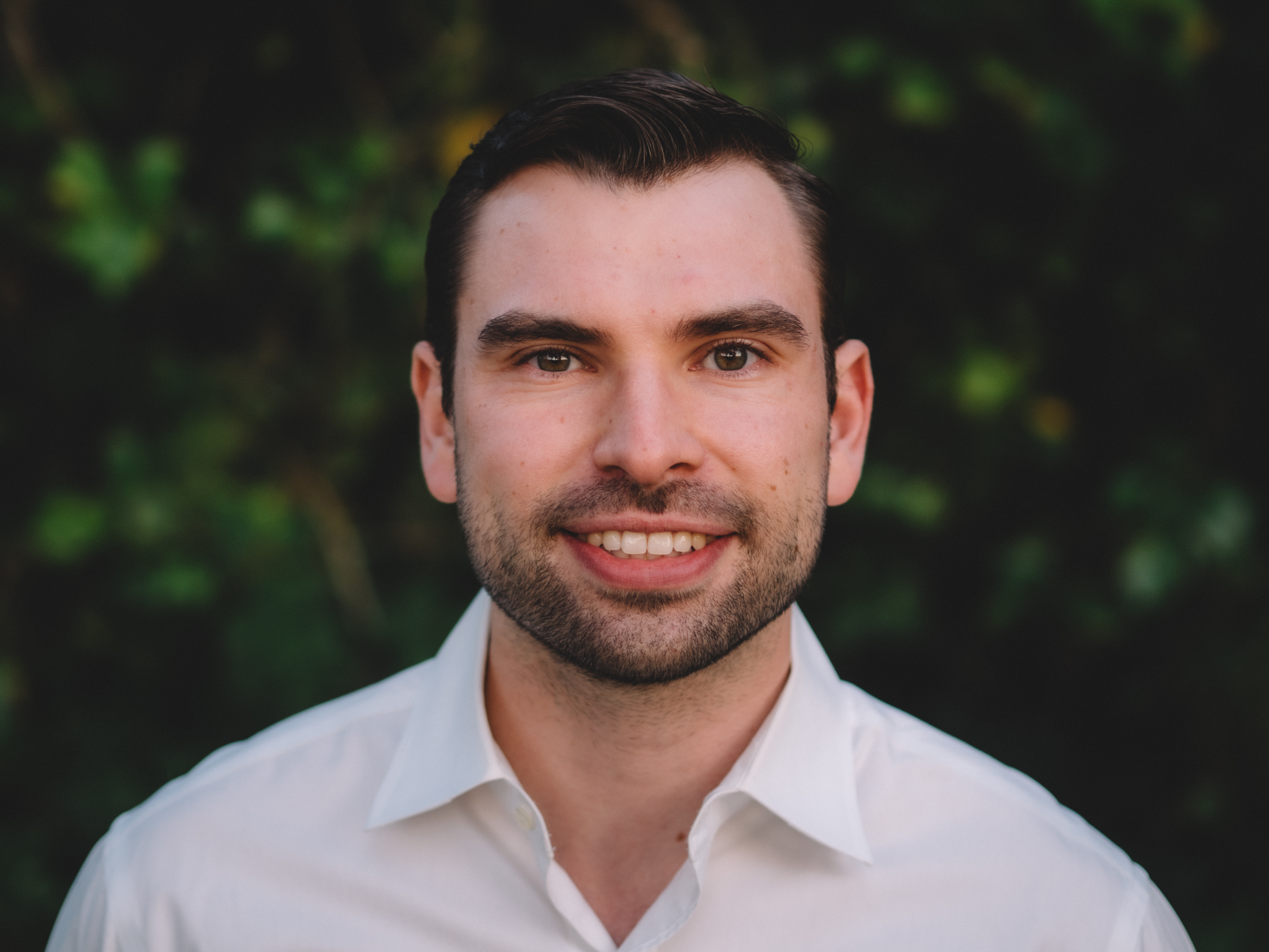
Zander Sebenius, A.B. '13, MBA '19
Working for SolarCity in 2015, Zander Sebenius saw how impactful it can be when new technology combines with business innovation. The company developed purchase power agreements (PPAs) for solar panels, essentially covering all upfront costs related to panel installation while billing the customer for the electricity. The customer typically still enjoyed a lower power bill, trading any tax incentives for not having to shoulder installation costs themselves.
“Combining existing technology with new business innovation enabled for the massive rollout of residential solar across the United States,” Sebenius said.
Sebenius, who studied environmental engineering at the Harvard John A. Paulson School of Engineering and Applied Sciences (SEAS), uses a similar approach to his current work. As Vice President of Project Investments at Rubicon Carbon in San Francisco, he helps find promising start-ups in the carbon reduction space, whether it’s through nature-based projects such as reforestation or technology-based innovations such as giant fans that scrub CO2 from the ambient air (known as Direct Air Capture). His current work builds on 13 years of working in renewable energy and clean technology.
“My north star has always been working on climate technologies with innovation from both the engineering and business sides,” he said. “The climate space is rich with opportunities, where you can apply both technical and business perspectives to unleash new business models that can make a positive impact on the world.”
A Cambridge native, Sebenius always had Harvard on his mind as a potential university. He arrived knowing he wanted to study at the intersection of environment and business, having been especially inspired by Thomas Friedman’s 2008 book Hot, Flat, and Crowded, which laid out a vision that investing in green technology would translate to both a stronger economy and healthier climate.
“The book really opened my eyes to this notion of being able to do well for the world and also have a successful career,” he said. “When I first got to Harvard, I didn't really know what concentration I wanted to study. I learned about the environmental engineering major, and I really am grateful that I followed that pathway.”
The environmental engineering track was relatively new when Sebenius came to Harvard, which allowed him to take a broad range of courses beyond the ones required for his concentration. Classes on photonics and power systems would prove critical once he began working in solar power, but even more invaluable was an understanding of how many different ways one could work in the energy and climate spaces.
“The engineering aspect has been extremely helpful in my career in terms of structured thinking and problem-solving,” he said. “What I've learned as I've gone out into the world is that just an interest in climate doesn't really map to a job. You can be a lawyer in the climate tech space. You can be an engineer. You can be an investment banker. You can be an accountant. I would implore everyone who is even a little bit interested in climate tech to try different angles.”
Four years after leaving SEAS, Sebenius returned to Cambridge to get his MBA from Harvard Business School (HBS). While at HBS, he co-founded a start-up called Greener Technologies, whose goal was to reduce energy consumption in the indoor agriculture space.
“I saw the importance of being able to match general problem-solving skills with really understanding how businesses worked,” he said. “Being able to go back and kind of formalize that piece of the education and then have that dual engineering and MBA background has been extremely helpful. There's no doubt in my mind when I'm looking at a problem that I understand enough about how the business side of it works, and I understand enough about the technical side.”
In his current work at Rubicon, Sebenius evaluates projects based on a range of criteria. If evaluating acarbon project developer that is planting forests, he selects for those that plant native species and that can support local biodiversity. He also evaluates projects for their integrity and measurability, ensuring that the project will actually remove as much carbon as it claims. There’s also project durability, meaning the lifecycle of the project. There are legal and procedural criteria, as every country has its own rules regarding carbon removal and issuing credits. And there’s the question of additionality, meaning if the carbon removal from the project would’ve happened without the intervention, in which case the project doesn't remove incremental carbon.
Sebenius’s team has funded both nature- and technology-based start-ups. But because the cost of planting a tree is so much lower than installing and maintaining many carbon-scrubbing technologies, nature-based solutions present a greater opportunity for lower-resource parts of the world.
“If you plant a treeit will have a very different life cycle than if you capture carbon and inject it into an old oil well, or turn it into calcium carbonate which will be stable forever,” he said. “It doesn't matter to the world whether a ton of carbon is sequestered in Ghana or in the US – it has the same impact on the atmosphere. Nature-based solutions are something that we can roll out rapidly right now at scale, and also come with a lot of other co-benefits like biodiversity, female empowerment, and creating economies in a way that some of the engineered solutions haven't been able to do yet.”
Sebenius’s career also includes stints with the Potential Energy Corporation climate non-profit and investments team at Carbon Streaming Corporation before joining Rubicon in 2025. As his career continues, he sees more and more need for investment in decarbonization and green solutions, especially with the rising power demands of artificial intelligence data centers.
“Carbon markets are fundamentally sustainable infrastructure,” he said. “You're growing forests, you're building things that are removing carbon. We're seeing a shift right now from a very bits-and-bytes focused world to a physical infrastructure world focused on actual atoms and electrons. This shift is exciting, because there are a lot of roles for engineers to be involved in the transition, both on the physical build-out but also on the investment and financing side.”
Press Contact
Matt Goisman | mgoisman@g.harvard.edu