News
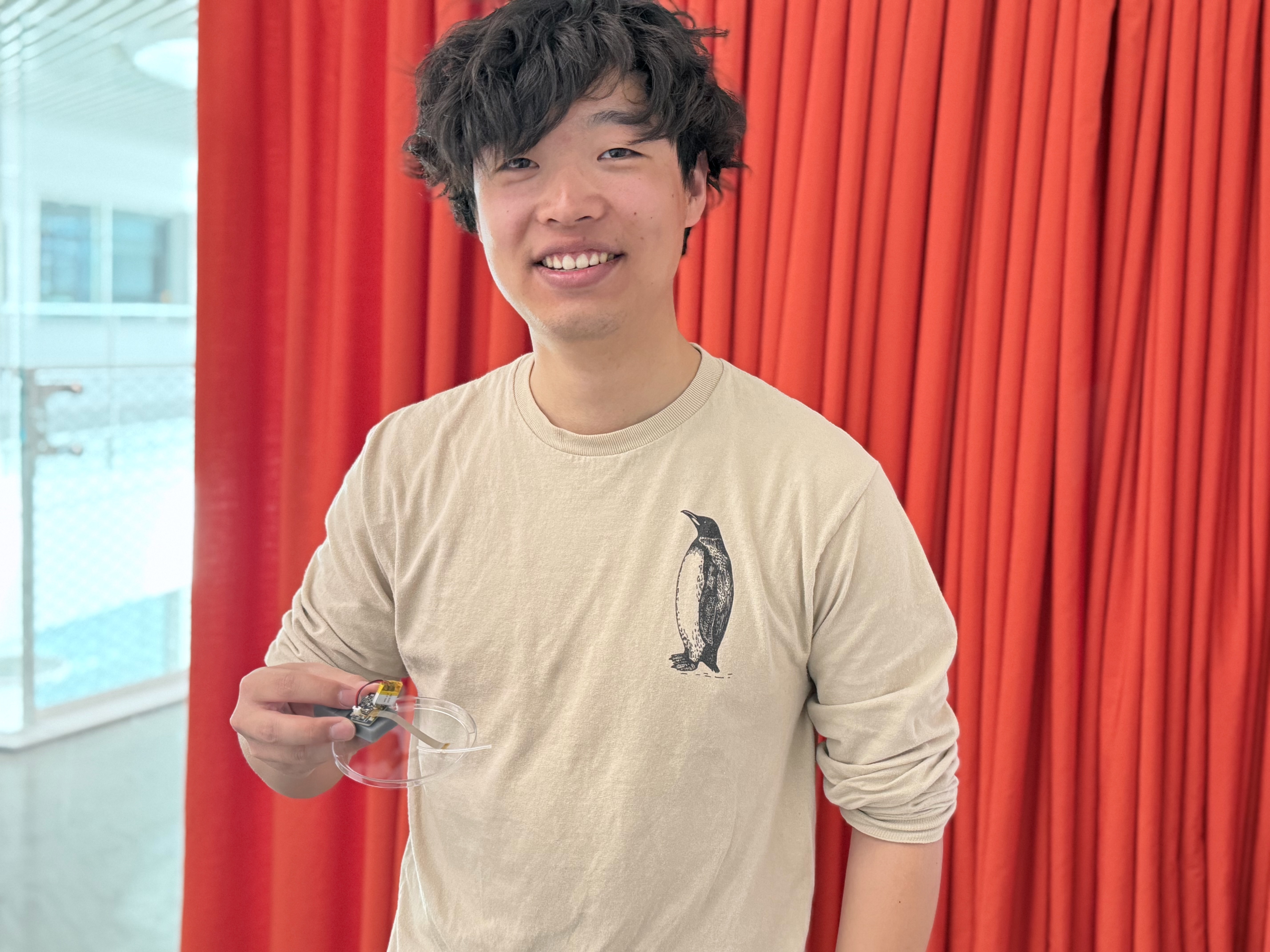
For his senior capstone project, Jerry Li built a device that stimulates nerves with with ultrasound therapy (Matt Goisman/SEAS)
Engineering Design Projects (ES 100), the capstone course at the Harvard John A. Paulson School of Engineering and Applied Sciences (SEAS), challenges seniors to engineer a creative solution to a real-world problem.
A Flexible PMUT-Based Ultrasonic Cuff for Beam-Steered Selective Vagus Nerve Neuromodulation
Jerry Li, S.B. '26, Electrical Engineering
Advisor: Hugh Herr, Evelyn Hu, Guillermo Herrera-Arcos, Jason Hou
• Please give a brief summary of your project.
I built a device that uses ultrasound to stimulate nerves — it's ultra-precise and less invasive than electrical stimulation, and could be useful for treating depression, epilepsy, or neuroprosthetic control.
• What real-world challenge does your project address?
To my knowledge, no one has used microfabricated ultrasound transducers for peripheral nerve stimulation before.
• How did you come up with this idea for your final project?
I have two wonderful mentors: Guillermo pushed me to look into innovations in ultrasound neurostimulation, and also introduced me to Jason, who had just published a paper on microfabricated ultrasound transducers for brain neuromodulation. I was curious if we could adapt Jason's transducers for peripheral nerve stimulation.
• What was the timeline of your project?
I started the microfabrication process back in May 2025, and worked on it over the summer. During the academic year, I've mostly focused on electronics design.
• What part of the project proved the most challenging?
Microfabrication takes a long time, even when you have someone very experienced guiding you through the process!
• What part of the project did you enjoy the most?
Tackling a highly interdisciplinary project and building confidence in my ability to learn on the fly: it spans everything from neuroscience and phased array theory to wireless charging and mechanical prototyping.
Topics: Academics, Electrical & Computer Engineering, Health / Medicine
Cutting-edge science delivered direct to your inbox.
Join the Harvard SEAS mailing list.
Press Contact
Matt Goisman | mgoisman@g.harvard.edu