News
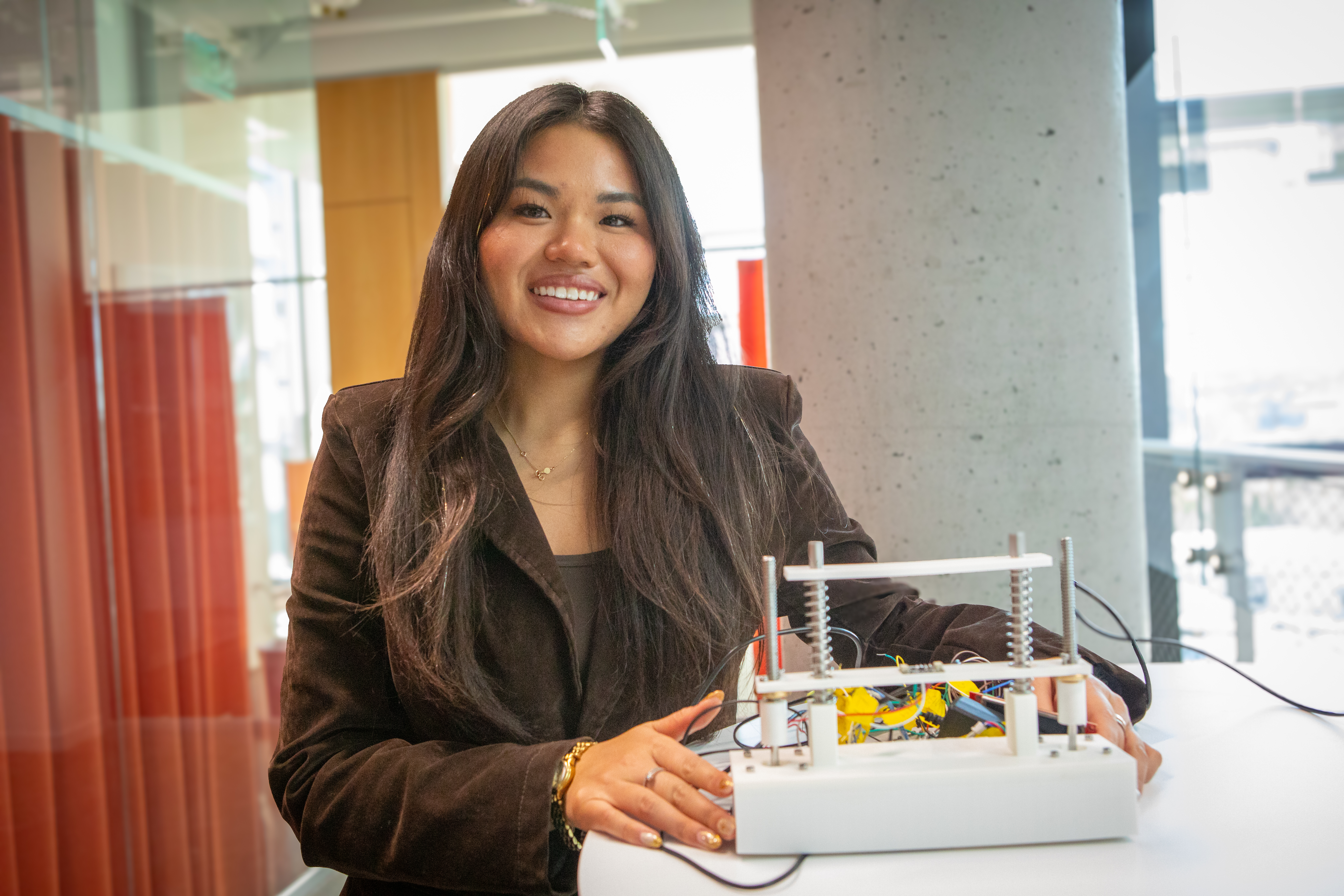
For her senior capstone project: Katie Le built a grip-strengthening device for rheumatoid arthritis patients (Eliza Grinnell/SEAS)
Engineering Design Projects (ES 100), the capstone course at the Harvard John A. Paulson School of Engineering and Applied Sciences (SEAS), challenges seniors to engineer a creative solution to a real-world problem.
Dynamic Physical Therapy Device for Rheumatoid Arthritis Patients
Katie Le, S.B. ‘26, Bioengineering
Advisor: Rima Rebei
• Please give a brief summary of your project.
My thesis is a dynamic grip-strengthening physical therapy device for rheumatoid arthritis (RA) patients. The device is able to measure a user’s grip force in real time and automatically adjusts resistance based on their current grip strength input.
• What real-world challenge does your project address?
This project addresses the real-world challenge of poor adherence to physical therapy (PT) in RA patients, as studies have shown that pain and fatigue are major barriers for RA patients to engage in PT. This device does this by being able to adjust resistance in real-time based on user input.
• How did you come up with this idea for your final project?
I came up with this idea by working with a PhD student who works with RA patients. I learned that many patients struggle to adhere to their physical therapy plans, especially during flare-ups when pain and fatigue are heightened. I also saw that existing devices (stress balls, grip trainers, etc.) only provide static resistances. Because of this, they are unable to adapt to the day-to-day fluctuations of pain and swelling experienced by the patient.
• What was the timeline of your project?
For the first semester, I spent the first few weeks on background research, defining the problem, meeting with occupational therapists, and creating my initial proposal. Then, I explored two main design approaches and selected a final approach, which took me another few weeks. I then created a rudimentary prototype. For the second semester, I spent approximately six weeks building and refining the first prototype, integrating springs, sensors, motors and 3D-printed parts. I further built upon the design, creating two more improved versions. I spent the remaining weeks performing validation tests and data analysis.
• What part of the project proved the most challenging?
The most challenging part of the project was when I had to pivot my device design. Initially, my design relied on motors being able to compress the springs in my device. However, the mathematical values I computed for the holding torque of my motors was still not enough. As a result, I had to pivot from a preload approach to a design that limits the maximum compression of the spring.
• What part of the project did you enjoy the most?
I enjoyed iterating on my device the most. It was exciting to see the different versions of my device and how each improved upon each other little by little.
• What did you learn, or skills did you gain, through this project?
Through this project, I became more comfortable pivoting. I also improved my CAD skills through the design process. I also developed a better workflow, allowing me to work effectively on my own.
Topics: Academics, Bioengineering, Health / Medicine
Cutting-edge science delivered direct to your inbox.
Join the Harvard SEAS mailing list.
Press Contact
Matt Goisman | mgoisman@g.harvard.edu