News
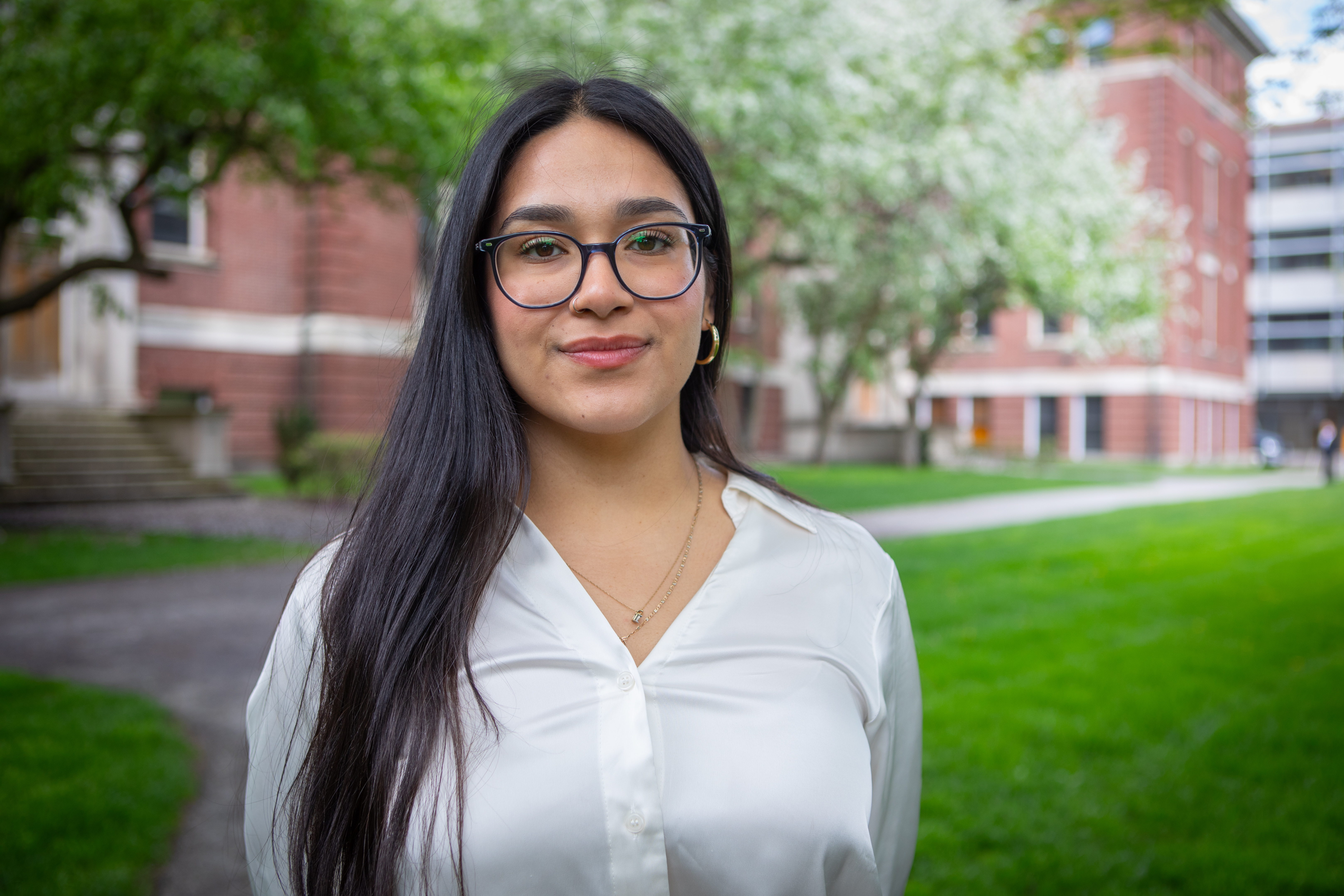
Lizbeth Ibarra, S.B. '26, in environmental science and engineering (Eliza Grinnell/SEAS)
Lizbeth Ibarra grew up next to an oil refinery, and every day she saw its impact on her community of Richmond in the San Francisco Bay Area. Her family and friends suffered from asthma and other respiratory illnesses. School days were sometimes cancelled for “smoke days” because the air quality was so bad. A 2012 fire at the refinery led to thousands of people seeking medical treatment.
“There's just a lot of things that I think I was desensitized to because they felt very normal, or they were just things that my family never questioned or talked about,” she said. “I remember every Wednesday in elementary school just hearing this alarm blaring and not knowing what it was, but later learning that it was just a refinery making sure that the alarm works in case some other kind of emergency happened. Those were really big things that I didn't realize until later on were impacting my community, which is predominantly low income and of color, while other communities nearby were not having any kind of experiences like that.”
As a high school student, Ibarra joined the climate activist group Youth vs. Apocalypse and became a member of the Path to Clean Air Committee for the Bay Area Air Quality Management District. But while she understood the impacts of climate change on communities, she didn’t know the underlying science. That brought her to Harvard, where she studied environmental science and engineering at the Harvard John A. Paulson School of Engineering and Applied Sciences (SEAS).
“Coming to Harvard was an opportunity to be able to bring something back to my community that a lot of people in my community had not had access to,” she said. “I felt like doing environmental science engineering was the right intersection for me.”
Now a senior, Ibarra is at the end of a journey that transformed her into a leader. She served as Head of Outreach for the SEAS-affiliated Harvard Society of Professional Engineers (SHPE) and led the Harvard Engineers Without Borders (EWB) project constructing a water distribution system in Los Sanchez, Dominican Republic. After 10 years of work, that project wrapped up last summer, and the club is now in the early stages of a new project in Mirador, Guatemala.
“Being able to be the project lead during this time in the project was such an honor and privilege,” she said. “I’d learned so much from everyone who had previously been involved in the project and who had already graduated, and I felt like I was able to honor them in the way that we closed off the project. It was really important for us to do it right and make sure that the community had all of the training that they needed and felt satisfied with the work that we had done.”
After graduating, Ibarra will be working for Pullman Services, a structural repair and strengthening company and contractor she interned with last summer. She worked on building restoration projects during her internship, which put her on a team working on the hospital wing at the Alcatraz Island prison. While excited, Ibarra is also thinking farther ahead towards a possible master’s degree, or working for organizations trying to improve air or water quality in her community
“I'm really excited to be able to be back in my community again and be back home,” she said. “But I am also interested in going to grad school for my parents who never had access to any kind of education.”
The youngest of four children, Ibarra is part of the first generation of her family to go to college. Harvard offered the best combination of academic freedom and financial aid, so she chose it over much closer colleges in the University of California or California State University systems.
“When I got in, I learned that Harvard was really trying to encourage students to explore their interests,” she said. “Getting into Harvard, it’s really hard to say no once you learn about everything that comes with being able to go here.”
Once she arrived, EWB provided Ibarra the opportunity to dive into real-world engineering, even as she completed core math and chemistry courses for her concentration.
“My advisor explained how club members get to work on real projects with local communities all around the world on international development projects,” she said. “As someone who does come from a Latina background, I felt like it was really cool that I'd be able to help make an impact in the DR. EWB gave me the opportunity to really learn what engineering is, and do that with other peers who were also very passionate about being able to improve the quality of life for other people.”
As a first-generation college student from a traditionally underrepresented group in engineering, Ibarra has tried to make it easier for students with similar backgrounds to navigate Harvard. She did that with SHPE, and also as a Senior Recruitment Ambassador with the Harvard College Admissions & Financial Aid Office.
“I'm very proud to be first-gen, because I feel like there's a drive that every first-gen student has that really pushes us to get things done and make things happen,” she said. “Prior to coming to Harvard, I didn't know any engineers, and then here at Harvard I knew very few engineers of color. So it just feels really nice to have been able to do something that I didn't think I could have ever done when I was younger.”
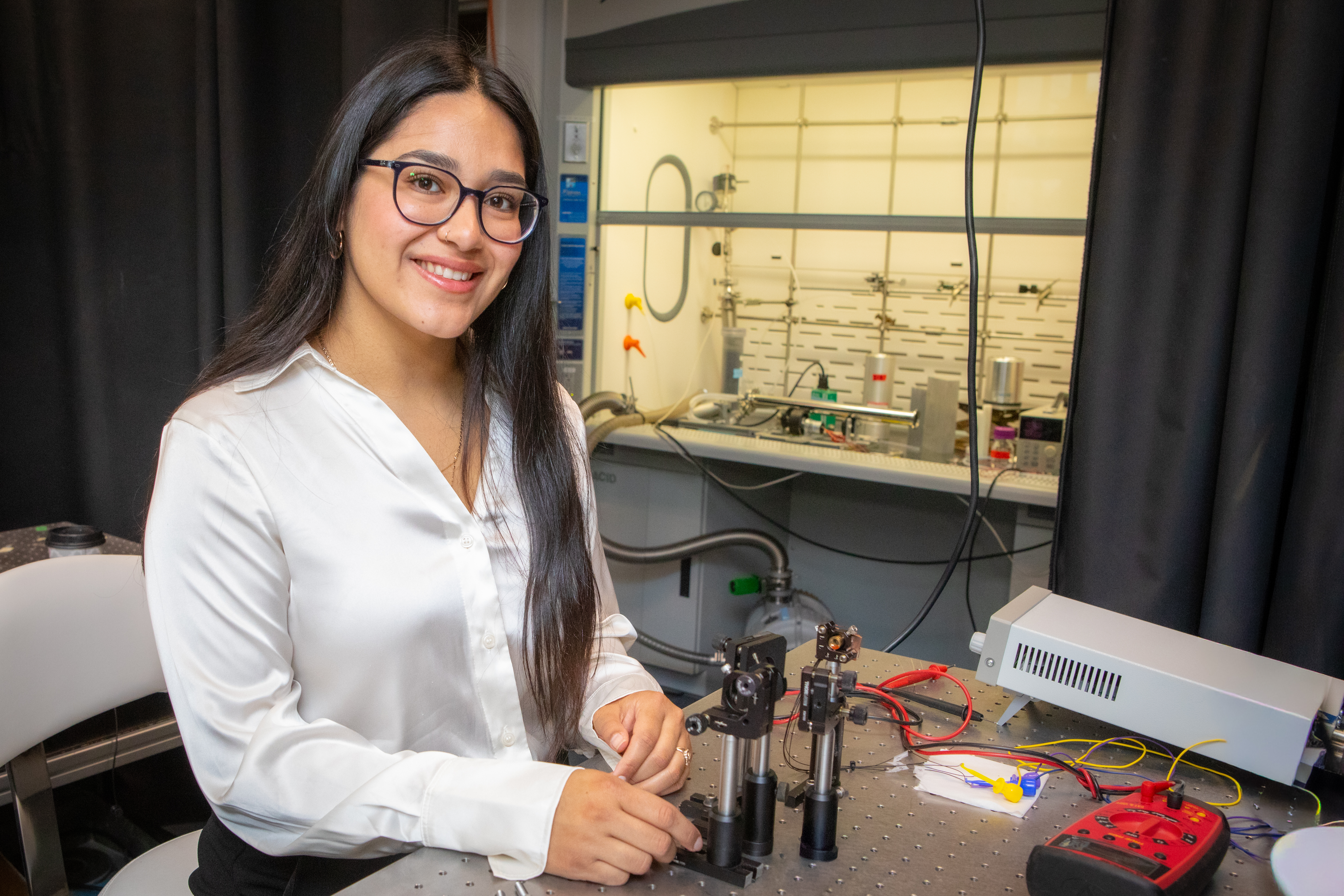
For her senior capstone project, Lizbeth Ibarra researched how to redesign the portable optical particle spectrometer, a tool used to measure the size and concentration of aerosols in the atmosphere (Eliza Grinnell/SEAS)
On the academic side, Ibarra’s coursework peaked with her senior capstone project. Advised by Frank Keutsch, Stonington Professor of Engineering and Atmospheric Science and Professor of Chemistry and Chemical Biology, and Ph.D. students in his lab, she worked on optimizing the design of the portable optical particle spectrometer, a tool used to measure the size and concentration of aerosols in the Keutsch Group’s atmospheric research.
“As a particle passes through a laser, the amount of light that the particle scatters is proportional to the particle's diameter,” she said. “The original design was collecting a lot of scattered light, but also missing a lot of light in the directions that light was predominantly scattering. So I was trying to look at how I can improve the light that's actually being collected in order to ultimately improve particle size measurements.”
After presenting her capstone, Ibarra couldn’t help but think back on who she was as a freshman, frustrated by her introductory courses and nervous about her future in the school. Over the ensuing four years, she grew into a true engineer: knowledgeable and capable of doing the very technical work required by her field.
“My senior capstone project, as much as it was technically challenging for me, it feels really nice to be able to serve as an example,” she said. “One of the biggest things that I'm gonna take with me is the fact that I really am capable of anything. Despite what resources I might have had access to, despite what my upbringing was, we really are capable of anything.”
Topics: Community, Climate, Environmental Science & Engineering, Undergraduate Student Profile
Cutting-edge science delivered direct to your inbox.
Join the Harvard SEAS mailing list.
Press Contact
Matt Goisman | mgoisman@g.harvard.edu