News
Key Takeaways
Harvard researchers set a new benchmark for enzymatic DNA synthesis by writing 64 distinct sequences in parallel on a semiconductor chip.
Their device is limited by deprotection chemistry, rather than electronics -- pointing to the next challenge of developing more localized, acid-driven chemistry to fully exploit the chip's DNA-synthesis capabilities.
Silicon chips have powered computing for half a century. Increasingly, they are also becoming platforms to read and manipulate biology at scale – recording from many neurons, reading many DNA sequences, and now, synthesizing DNA.
In a study published in Nature Electronics, a Harvard-led team reports a silicon chip that synthesized 64 distinct DNA sequences on its surface in parallel – not by using the solvent-heavy chemistry that dominates custom DNA manufacturing today, but through a water-based enzymatic process. The chip choreographs the parallel enzymatic synthesis, using finely controlled electric currents to trigger local reactions site by site. The research was led by Donhee Ham, the John A. and Elizabeth S. Armstrong Professor of Engineering and Applied Sciences at the John A. Paulson School of Engineering and Applied Sciences (SEAS).
Chip writes DNA in water
Synthetic DNA underpins modern biology and medicine – diagnostics, genome engineering, cancer research. Most of it is made today by phosphoramidite chemistry, an established process that can produce millions of sequences in parallel but depends on hazardous organic solvents and centralized facilities.
Enzymatic DNA synthesis is emerging as a milder, water-based alternative, closer to how living cells build DNA, and could ultimately support smaller, safer and more accessible DNA-writing instruments. But it hasn’t come close to being able to produce the number of sequences in parallel that phosphoramidite chemistry can. To date, enzymatic synthesis has only been able to produce up to a dozen DNA sequences at a time. Against that backdrop, the Harvard team’s demonstration of synthesizing 64 distinct sequences in parallel, each up to 39 nucleotides long, sets a new benchmark.
DNA synthesis proceeds one nucleotide at a time. Each newly added nucleotide carries a temporary blocking group that prevents further growth; to add the next nucleotide, that group must be removed. This step, called deprotection, can be triggered by acidity, or low pH, in water.
In parallel synthesis, the challenge is to lower pH only at the sites scheduled to receive the next nucleotide in each cycle. The Harvard chip, with 64 synthesis sites on its surface, meets this challenge electrochemically. Each site contains two concentric ring electrodes surrounding DNA anchored at the center. At a chosen site, the chip electronics drive current into the inner ring to generate protons – lowering the pH right at the DNA strands for their enzymatic elongation. At the same time, the chip pulls current from the outer ring to consume diffusing protons, keeping the low-pH zone from spreading outward. In each cycle, the chip switches on this low-pH operation only at the sites due for a nucleotide. Cycle by cycle, this spatial pH patterning grows 64 distinct DNA sequences.
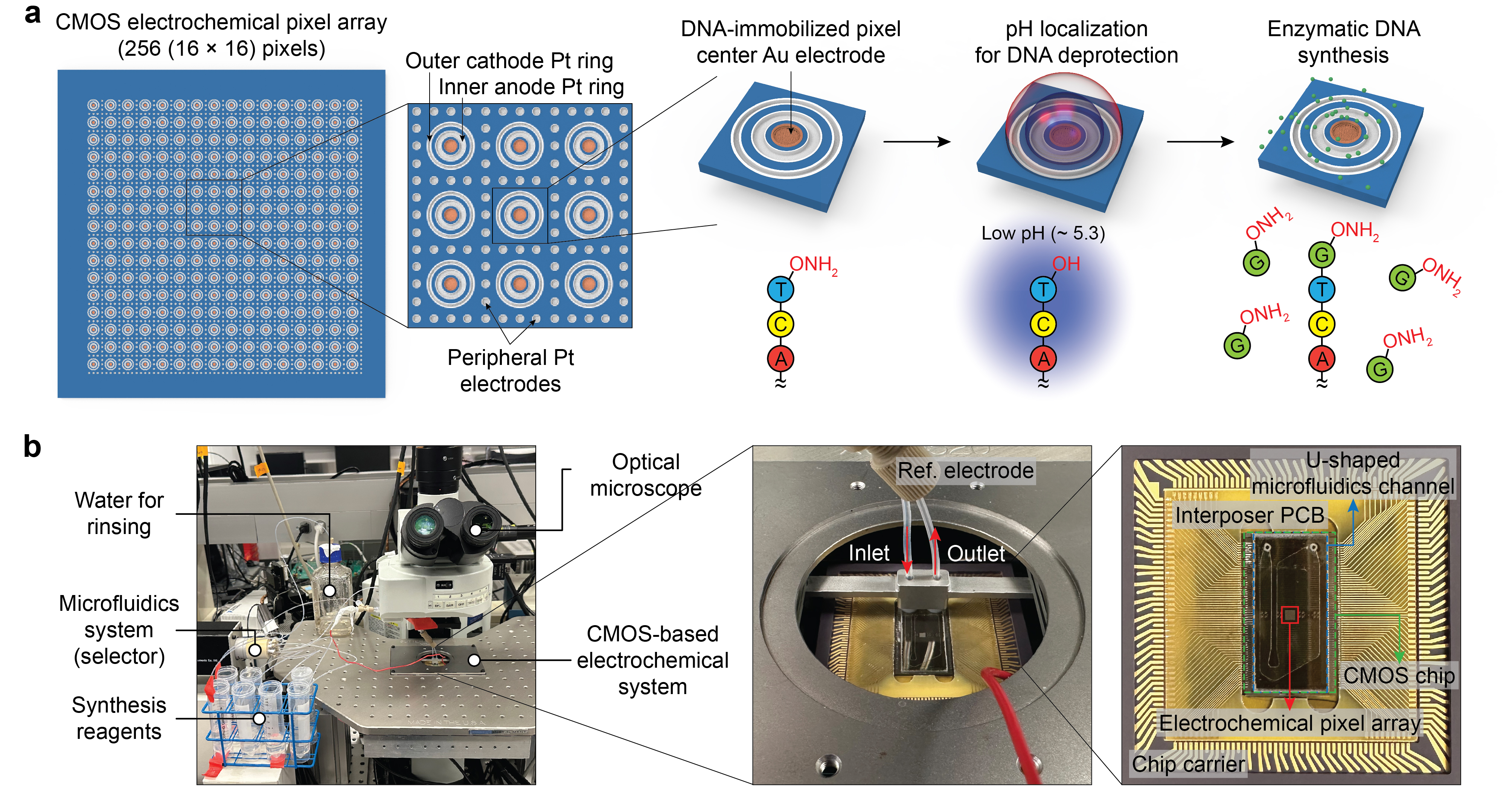
A schematic of core steps in the enzymatic synthesis platform.
The silicon electronic chip itself was designed in Ham's lab by Jeffrey Abbott, a former PhD student, for population-scale intracellular neuronal recording. By reworking the surface electrodes, Ham’s group has since widened the use of this same electronic backbone, from intracellular recording of thousands of neurons – first extracting hundreds of synaptic connections, then tens of thousands – to orchestrating DNA synthesis.
“A defining feature of the chip was precision current injection, which we used to permeabilize neuronal membranes for intracellular access,” Ham said. “At a certain point, we wondered whether that same current control could be redirected from cells to molecules – replacing the neuron-facing electrodes with ring-electrode pairs that could localize pH for DNA synthesis. It worked.”
Beyond nearer-term uses in synthetic biology and diagnostics, the team also used the 64 sequences to encode a 169-byte text, illustrating a longer-term possibility: DNA-based data storage. DNA data storage remains a more distant application because it would require DNA synthesis at enormous scale. But that scale is also what makes a water-based enzymatic route attractive: as the amount of DNA to be written grows, solvent use and environmental burden become increasingly important.
“DNA data storage asks DNA synthesis to operate at a scale far beyond today’s needs,” said Woo-Bin Jung, co-first author of the study and now an assistant professor of chemical engineering at the Pohang University of Science and Technology (POSTECH), who carried out the work as a postdoctoral researcher in Ham’s lab. “That is why enzymatic synthesis in water can matter. If far more than 64 sequences can be synthesized in parallel, it could offer an environmentally friendly route toward writing DNA at very large scale.”
Chemistry sets the next challenge
The ambition to write far more than 64 sequences left one final question: How far could the chip be pushed? To find out, the team tried denser synthesis, using more closely spaced synthesis sites fabricated on the same silicon chip. The attempt failed, but it produced one of the paper’s most important findings. At first, the result was puzzling because the chip was localizing low pH well. Through painstaking experiments, the team traced the problem not to the electronics but to the deprotection chemistry used in the study. Low pH does not directly remove the blocking group from DNA; instead, it generates intermediate molecules that perform deprotection. Those intermediates can drift to neighboring sites, escaping the very confinement that worked so well for the pH itself, and blur the boundary between sites.
“The chip did what we asked it to do: it localized low pH at selected sites,” said Han Sae Jung, co-first author of the study and a former graduate student and current postdoctoral researcher at Harvard. “The limitation came from the deprotection chemistry, not from the silicon. That leaves a clear next step for the field — develop a more direct acid-driven deprotection chemistry that can keep pace with the chip.”
The work was a multi-institution collaboration including Harvard, the Broad Institute, DNA Script, and later POSTECH. Intellectual property related to the platform has been filed through Harvard's Office of Technology Development. The paper is titled “Parallel enzymatic DNA synthesis using a semiconductor chip.”
This research is based upon work supported in part by the Office of the Director of National Intelligence (ODNI), Intelligence Advanced Research Projects Activity (IARPA), via 2019-19081900002, Horizon Europe, Hyperion project ID: 101115253, and Samsung Research Funding & Incubation Center for Future Technology of Samsung Electronics under Project Number SRFC-IT2402-09.
Topics: Electrical & Computer Engineering, Materials, Research, Technology
Cutting-edge science delivered direct to your inbox.
Join the Harvard SEAS mailing list.
Scientist Profiles
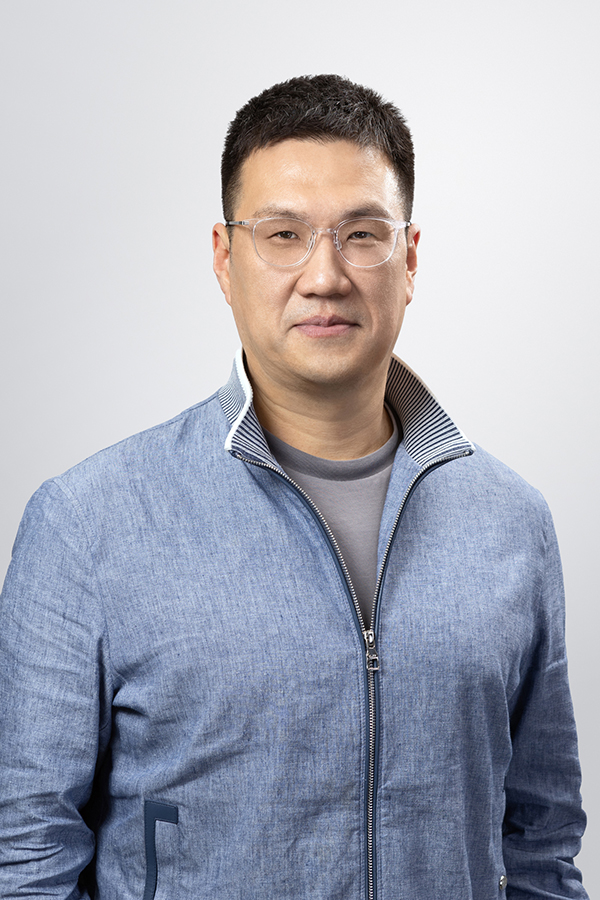
Donhee Ham
John A. and Elizabeth S. Armstrong Professor of Engineering and Applied Sciences
Press Contact
Anne J. Manning | amanning@seas.harvard.edu
Related News

Applying AI to Accelerate Design, Test and Manufacture
University of Washington Mechanical Engineering
AI / Machine Learning, Applied Physics, Computer Science, Electrical & Computer Engineering, Materials Science & Mechanical Engineering, Meet Our Faculty, Research, Technology