News

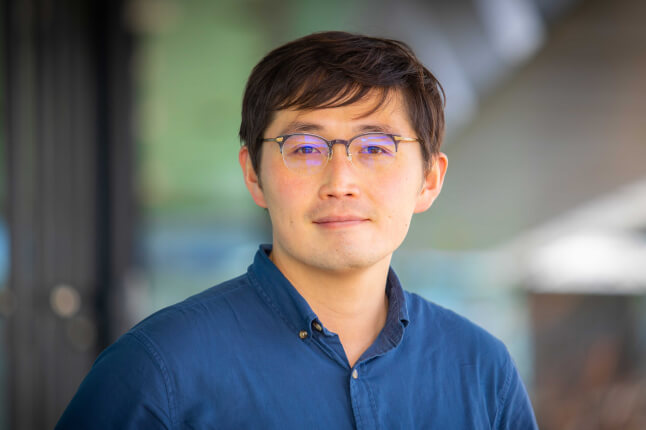
Ricky Sakai, Senior Vice President of Investment and Business Development at Mitsubishi Heavy Industries America (MHI), speaking at the Global Energy Transition seminar.
What will it take to reinvent heavy industry for a net-zero future? According to Ricky Sakai, Senior Vice President of Investment and Business Development at Mitsubishi Heavy Industries America (MHI), the answer lies in bold engineering, global collaboration, and urgent action.
Speaking at a recent Global Energy Transition talk sponsored by the Environmental Science and Engineering area of the Harvard John A. Paulson School of Engineering and Applied Sciences (SEAS) and moderated by SEAS Research Associate Nicola De Blasio, Sakai described MHI’s shift from its traditional industrial businesses toward decarbonization. He outlined a strategy focused on large-scale engineering projects, coordination across national policy frameworks, and partnerships with startups to support the global energy transition.
Sakai traced Mitsubishi’s roots back to Japan’s industrialization in the mid-19th century. The Mitsubishi group was founded in 1870 as a shipping company and grew alongside Japan’s modernization. Mitsubishi Heavy Industries (MHI) was established in 1884. Today, it employs around 80,000 people worldwide, including about 11,000 in the United States, and reported $33.6 billion in revenue in 2024. With its Americas operation headquartered in Houston, MHI develops a range of products across energy, infrastructure, materials, and mobility.
Engineering the energy transition
Sakai framed the energy transition as fundamentally an engineering challenge. Climate goals, he said, ultimately translate into engineering constraints: generation must connect to turbines, transmission lines must stretch hundreds of miles, and systems must balance performance, reliability, and cost, all while infrastructure assets are expected to last 30 to 50 years.
“Deployment is the real innovation,” Sakai said, highlighting that scaling new technologies requires years of iteration and integration into existing systems.
Japan’s unique energy context shapes MHI’s approach. The country imports about 90% of its energy and depends heavily on industries like steel and chemicals. Renewable energy is harder to expand because Japan has limited land, mountainous terrain, and deep coastal waters. After the Fukushima disaster, only 14 of the country’s more than 50 nuclear reactors have restarted. Because of these factors, Japan places high importance on keeping energy reliable and affordable, and it operates one of the world’s most dependable power systems.
Despite constraints, Japan has built more than 123 gigawatts of renewable capacity and 37 liquefied natural gas import terminals over the past six decades. Once considered infeasible, liquefied natural gas is now Japan’s primary energy source — a reminder, Sakai noted, that ambitious energy transitions can succeed over time.
From products to investments
MHI’s current portfolio still largely involves fossil fuel-based systems, Sakai acknowledged, making decarbonization a complex task. The company is prioritizing electrification and low-carbon fuel conversion while expanding investment beyond its legacy businesses.
Six years ago, MHI established a corporate arm designed not only to invest in startups but to help scale them. With more than 1,500 research engineers, the company aims to bridge the gap between startup innovation and industrial deployment, investing in hydrogen, geothermal, energy storage, and carbon capture technologies.
“Startups are good at going from zero to one,” Sakai said. “We’re good at going from one to 100.”
Policy contrast: Japan vs. U.S.
Sakai pointed out sharp contrasts in energy policy between Japan and the United States. In Japan, the government leads the transition. It is slowly introducing carbon pricing through its GX Emissions Trading Scheme and plans to spend about $140 billion over 10 years to support the shift.
In the United States, the approach relies more on market incentives and subsidies. The federal government has committed hundreds of billions of dollars to clean energy in recent years, though some hydrogen funding has been delayed or reduced. Sakai noted that the lack of a consistent national hydrogen policy has slowed large-scale projects in the U.S.
One example of working across borders is the Blue Point Blue Ammonia Project in Louisiana, a partnership that includes JERA — Japan’s largest power generation company — and others. The project aims to make low-carbon ammonia in the U.S., using federal tax credits like 45Q and 45V, and support from the Japanese government. The ammonia will be sent to Japan to help reduce coal use in power plants. Sakai described the project, supported by both Japanese and U.S. subsidies, as a best-practice model of international collaboration.
Case studies: Hydrogen, CCUS, eceothermal ecosystems
MHI is building what Sakai calls a “hydrogen ecosystem,” investing in different types of hydrogen: green, turquoise, and white. The company recently tested a gas turbine that runs entirely on hydrogen and is now working to bring it to market. In Utah, MHI is creating a large green hydrogen project that will store hydrogen in underground salt caverns and mix it with natural gas for power, aiming to use 100% hydrogen by 2045. The project is supported by funding from the U.S. Department of Energy’s Loan Programs Office. Sakai pointed out that expanding hydrogen use faces challenges with policy, cost, and infrastructure.
For carbon capture, use, and storage, MHI is building a complete system to capture, transport, and store carbon. The company is working with ExxonMobil on carbon solutions and exploring low-carbon energy for data centers, which could need more than 100 gigawatts of new reliable power in the next five to six years.
MHI is also working on geothermal systems as part of its mix of energy projects. In Utah, the company is developing a 500-megawatt geothermal project that could add more clean energy across the western United States.
Long-term industrial realism
Throughout his remarks, Sakai returned to the importance of “engineering realism”, or taking a long-term, practical approach that balances new technologies with reliable operations.
He argued that companies can’t depend only on government incentives. They need to build systems that are profitable and can work at scale in different markets and policy environments.
“We have to manage breakthrough technologies within real-world systems,” Sakai said. “That’s how we make net zero achievable.”
Topics: Climate, Environment, Environmental Science & Engineering, Industry, Technology
Cutting-edge science delivered direct to your inbox.
Join the Harvard SEAS mailing list.
Press Contact
Anne J. Manning | amanning@seas.harvard.edu
Related News

Applying AI to Accelerate Design, Test and Manufacture
University of Washington Mechanical Engineering
AI / Machine Learning, Applied Physics, Computer Science, Electrical & Computer Engineering, Materials Science & Mechanical Engineering, Meet Our Faculty, Research, Technology