News
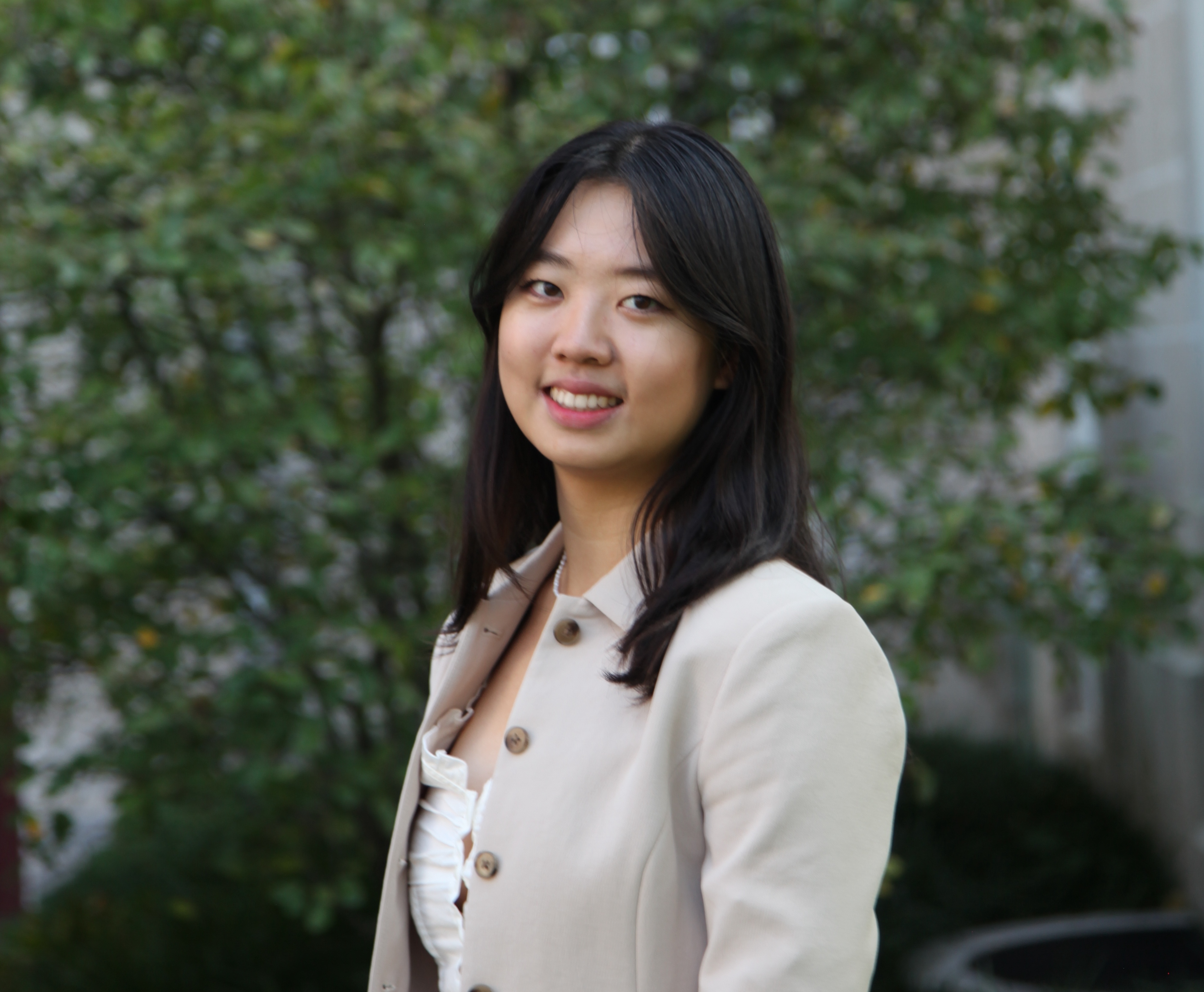
Amy Zhang, A.B. '29
When Amy Zhang learned about the Zhou Laboratory at the Dana-Farber Cancer Institute, she knew where she wanted to spend her summer. The lab drew on her interests in bioengineering and computation, and she was drawn to the lab’s ultimate goal of designing proteins, specifically antibodies, that could improve drug therapies and delivery.
“I want to be able to apply engineering principles to biology,” she said. “With a lot of protein design, you're kind of altering how a biological system behaves to get a desired treatment outcome from the drugs that you're creating. This past summer I discovered that engineering for biology was something that I was really interested in. I got to make things that are biological compounds, but I also got to test them out, design them, and incorporate other tools to make a refined product.”
Zhang, a second year bioengineering student at the John A. Paulson School of Engineering and Applied Sciences (SEAS), joined the Zhou Laboratory as part of the Program for Research in Science and Engineering (PRISE) Fellowship, a summer program run through the Harvard College Undergraduate Office of Research and Fellowships that connects students with faculty-mentored research projects. For Zhang, who was already planning to pursue a Ph.D. after completing her bachelor’s degree, that was the exact research environment she wanted.
“I reached out in December, got to tour the lab, met a lot of the lab members, and I really liked it,” she said. “I was looking for available mentors in the lab, and so I was matched up with a postdoc student. A great thing over the summer was that I was able to work on three projects at once, and I did have flexibility in which directions I wanted to explore.”
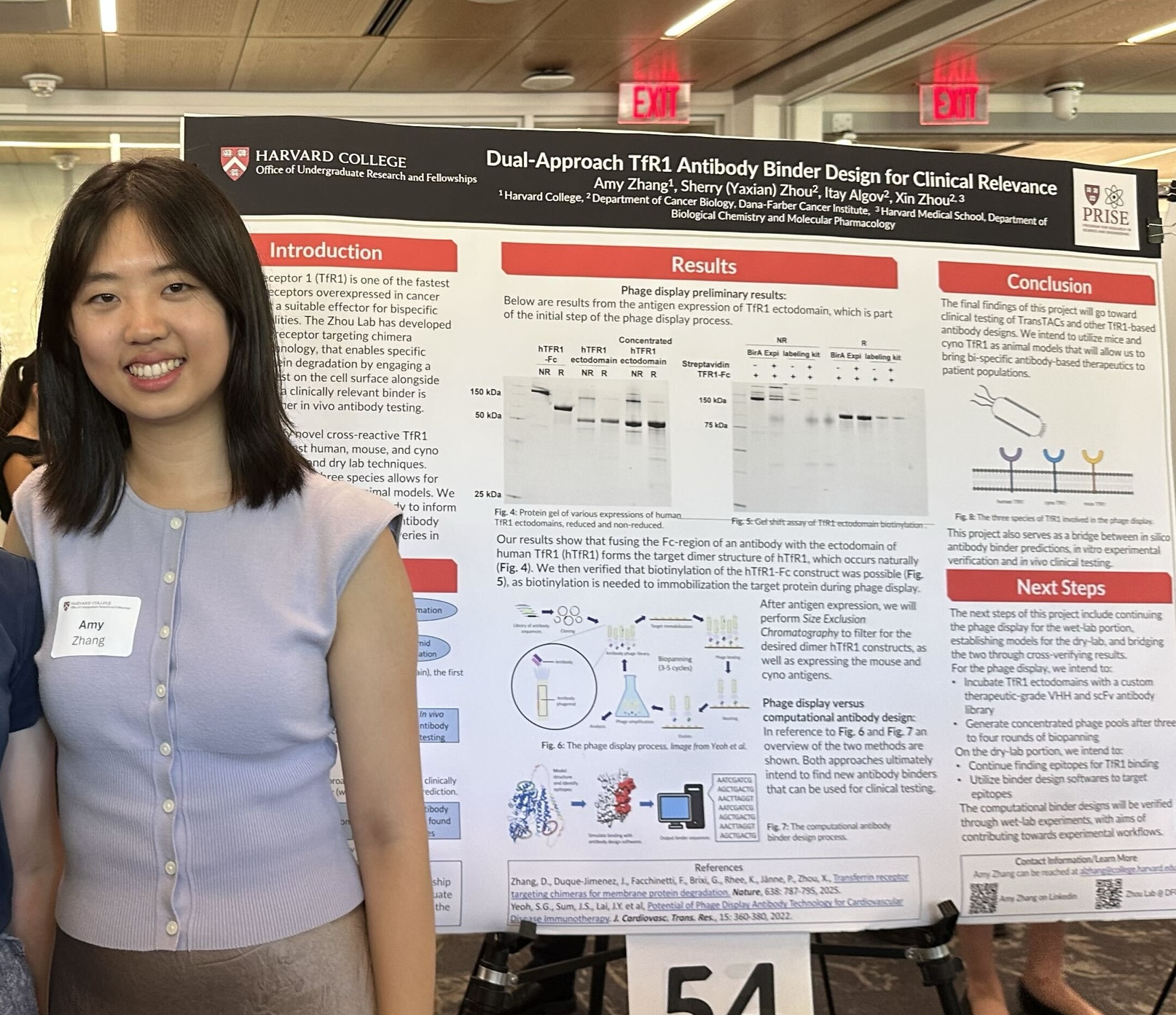
Amy Zhang presents her research at the Harvard PRISE research fair
Zhang’s research areas combined computational protein design and hands-on wet lab experience. She focused on both antibody drug conjugates, a class of cancer-fighting drugs that combine the specificity of human immune cells and the overall power of chemotherapy, as well as developing bi-specific antibodies that bind an internalizing receptor on the cell surface along with a target antigen to better facilitate cancer cell destruction.
“Right now, since we have a lot of these antibody designs, a big thing that we do need is binders,” she said. “There's a lot of various different combinations of amino acids that you can have for one binder, but artificial intelligence can help you design them. It's a lot more effective and efficient, because you can do it more quickly and don't have to go through the whole wet lab process of trying to evolve a suitable protein.”
For Zhang, combining AI and drug delivery felt like being on the forefront of both computer science and drug development.
“It was great, because I got to be hands-on in the lab and express these proteins and antibodies, but I also got to look at how an AI prediction of some of these sequences can be used,” she said.
Along with engaging in fascinating research, Zhang also left the PRISE Fellowship with broadened interests in engineering. She may choose a joint concentration in biomedical engineering and computer science, and even if she doesn’t, she might look deeper into the CS curriculum as she plans out the back half of her time at SEAS.
“Bioengineering is very broad,” she said. “You can work with medical devices, but you can also work with drug discovery, or engineering cells to have enhanced abilities. This fellowship definitely solidified my understanding of the field, and also helped me find a direction that I found particularly interesting. Definitely this experience really enhanced my understanding of the engineering field and where I want to contribute to, but also of the wide variety of courses that SEAS offers and the faculty that I'd also like to reach out to in the future.”
Even with graduate school as her intended next step, Zhang also wants to experience other forms of research before leaving SEAS. She said she may look into interning at a biotech start-up next summer, so as to understand the differences in research environments.
“What's nice is that in my lab there was a Ph.D. student that was also interning at a biotech company this summer, so I got to talk with her a little bit about that,” she said. “I definitely want to try that out, but I know I really do like research, and so I would be happy going to grad school in the future.”
Topics: Undergraduate Student Profile
Cutting-edge science delivered direct to your inbox.
Join the Harvard SEAS mailing list.
Press Contact
Matt Goisman | mgoisman@g.harvard.edu