News
Key Takeaways
- Harvard engineers used standard industrial weft knitting to create dense fabrics that snap between multiple stable 3D shapes, turning ordinary textiles into mechanical metamaterials.
- By embedding conductive yarns, they showed that multistable fabrics can function as soft, stretchable switches or sensors.
Knitting has come a long way from sweaters and blankets.
Researchers at the Harvard John A. Paulson School of Engineering and Applied Sciences (SEAS) have turned everyday knitting into a powerful platform for making shape-shifting devices that can act as switches, sensors, and more — paving the way to next-generation functional, programmable textiles.
The researchers created unique, machine-knitted fabrics that “snap” between multiple stable shapes, exhibiting a quality known to physicists as multistability. The work was led by recent Ph.D. graduate Kausalya Mahadevan, currently a postdoctoral associate in the lab of Katia Bertoldi, the William and Ami Kuan Danoff Professor of Applied Mechanics. The research is published in Advanced Functional Materials.
“I’ve always been excited about fabrics and textiles, and what we can engineer and build with them,” said Mahadevan, who began working in Bertoldi’s lab as an undergraduate. “Our ideas around multistability in textiles arose from being inspired by textile artists and how they approach structures, combined with how [Bertoldi’s] lab has traditionally thought about nonlinear mechanics in solids. We tried to approach thinking about textiles in that context.”
Structures that curve and retain their shape are more typically molded from polymers and created by carefully programming residual stress within the material. In the new study, the researchers show that weft knitting – the same industrial process used for making hats and gloves – can generate more complex curvatures with nothing but yarn.
They chose highly elastic yarns and employed a technique called plating, which exposes different yarns on each face of the fabric. They were able to produce dense, thick textiles that naturally curl into three-dimensional shapes, exploiting the same basic mechanism of when a cut T-shirt curls up from the bottom.
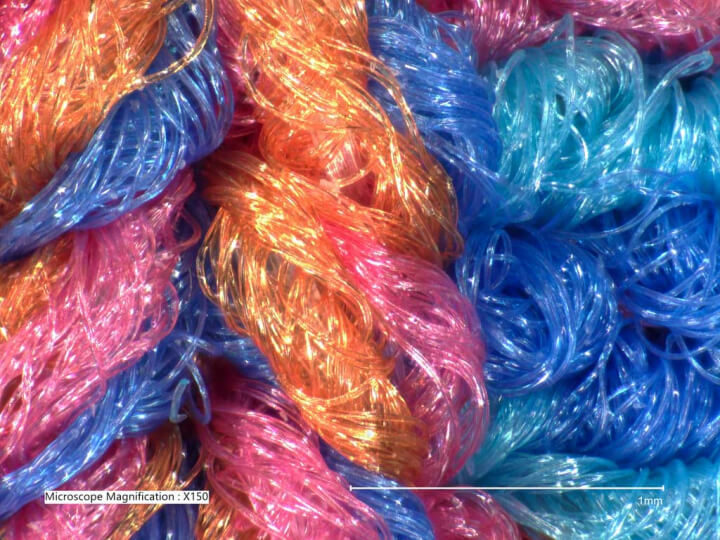
The researchers used highly elastic yarns to create dense textiles that snap into different configurations.
“The yarn selection and machine parameter choices allowed us to basically select a fabric that is going to be as snappy as we can possibly get,” Mahadevan said.
By systematically combining horizontal and vertical stripes, they built fabrics that snap and settle into more than one stable configuration, like how a light switch has an on and off function. By mapping how geometry and material choice affected the snap-through behavior, they identified the physical regimes in which their knitted textiles became multistable. They were also able to accurately model the textiles’ behavior using simulations that treat the textile as a continuous material, rather than tracking each individual yarn.
To demonstrate potential applications, the researchers embedded fine conductive yarns into their knits, turning the fabrics into soft, stretchable, electric switches that change state as the textile snaps back and forth.
They created, for example, a multistable knitted shell shape that turns an LED on and off as it flips between states. They also made a wearable textile switch that, when mounted over the knee or elbow, creates a snapping motion can be read by an Arduino to count steps. Finally, they designed a reconfigurable lamp shade with three separate multistable switches, each controlling a different color of light as the fabric stretches and snaps. These and other devices were the subject of a recent Art Lab installation.
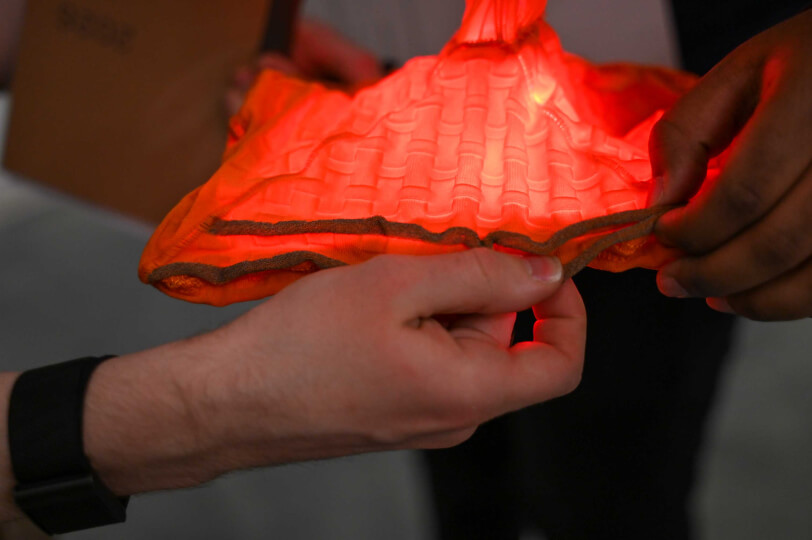
The researchers made a reconfigurable lamp shade with multistable switches that correspond to different colors of light.
The machines Mahadevan and the team used are similar to standard industrial knitting machines in garment factories, pointing to rapid scalability of future devices.
Scientifically, the project edges textiles closer to the broader field of nonlinear mechanical metamaterials, where structures are engineered to bend, buckle and snap in useful ways. Looking ahead, Mahadevan is intrigued by the possibilities of using multistable control to design textiles that are soft, seamless and functional. The team envisions fabrics that unobtrusively monitor movement, provide tactile feedback, or even morph into new shapes on demand.
The research was supported by NSF grant DMR-2011754 and ARO MURI program W911NF-22-1-0219. Equipment was supported by ONR DURIP Award N00014-19-1-2220.
Topics: Applied Physics, Graduate Student Profile, Materials, Materials Science & Mechanical Engineering, Research, Wearable Devices
Cutting-edge science delivered direct to your inbox.
Join the Harvard SEAS mailing list.
Scientist Profiles

Katia Bertoldi
William and Ami Kuan Danoff Professor of Applied Mechanics
Press Contact
Anne J. Manning | amanning@seas.harvard.edu