News
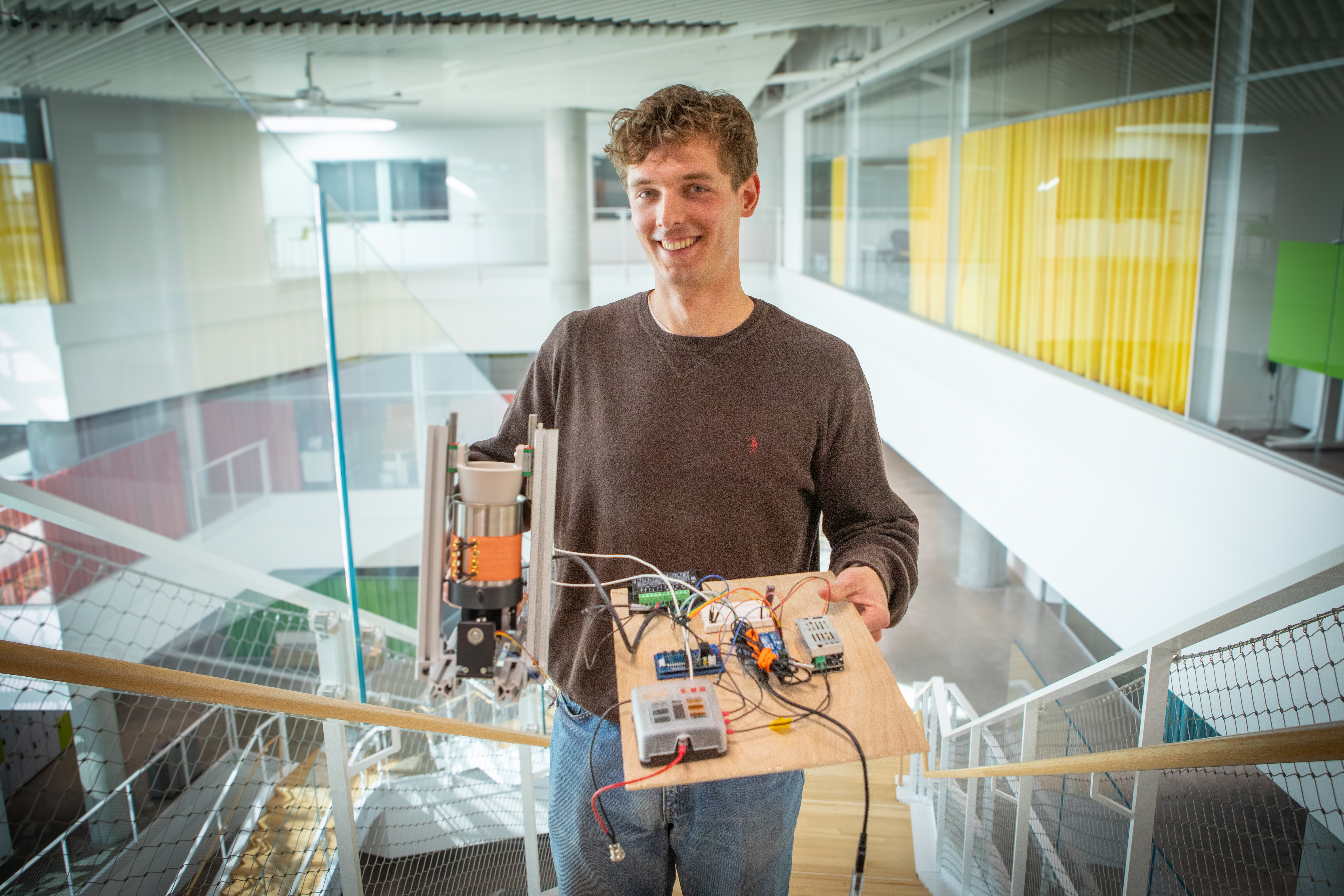
For his senior capstone project, Owen Marcovitz devised a way to measure microplastics released as dental implants wear down (Eliza Grinnell/SEAS)
Engineering Design Projects (ES 100), the capstone course at the Harvard John A. Paulson School of Engineering and Applied Sciences (SEAS), challenges seniors to engineer a creative solution to a real-world problem.
Oral Environment Simulator For Measuring Microplastic Detachment From Orthodontic Appliances
Owen Marcovitz, S.B. ‘26, Mechanical Engineering
Advisor: Joost Vlassak
• Please give a brief summary of your project.
My project is a dental wear simulator, designed to measure how many microplastics are coming off of orthodontic appliances like Invisalign. It has a weighted pin whose tip simulates a molar cusp that presses down upon a sample which slides back and forth underneath it, just like how teeth grind against each other. It also maintains an ambient testing environment of artificial saliva held at human body temperature (37°C). You can take just about any material, stick it inside the device, and get an idea of how it wears down over time inside the human mouth. While most dental wear simulators are meant to test crown/filling materials, this one was purpose built to enable a study of how plastic orthodontic appliances wear down over time. That way, we can quantify the microplastic exposure that these appliances might be causing patients.
• What real-world challenge does your project address?
This project addresses the underexplored research question: do plastic orthodontic appliances pose a risk of harmful microplastic exposure? This device will allow for the most comprehensive study to date.
• How did you come up with this idea for your final project?
This project was proposed to me last year by my advisor Joost Vlassak. He had read a 2023 study which similarly sought to measure microplastic detachment from orthodontic appliances. The issue with this study is that it did not actually bring the plastic into contact with any other solid material. Instead, to simulate oral frictions, it merely swirled artificial saliva around a retainer. So the idea with this project is that it will allow for an improved study: one which maintains the conditions of the 2023 paper, but also includes solid-on-solid contact to better simulate the oral environment. I'll be on the lookout for when it gets published!
• What was the timeline of your project?
I spent the first couple months just doing a deep-dive into the literature around dental wear simulators. This allowed me to make decisions on the ranges of parameters that my device would support, such as the length of the grinding path, cycles per minute for the device, and best materials to simulate a human molar. During that time I was also working on a preliminary design, getting an idea of how the overall structure would look. Months three and four were mostly about acquiring all the necessary parts to build my first prototype, including raw materials which I had to machine into custom parts. The last three months were mostly spent on programming and integration. I also spent the better part of a month working on the program which allows the user to program in the desired motion parameters and run tests from their computer.
• What part of the project proved the most challenging?
The biggest challenge was becoming well-read enough on the literature to fully justify each decision I was making. While it was fairly simple to come up with a prototype that fulfilled the device's requirements in broad strokes, it was very challenging to ensure that my design actually aligned with the literature, and actually supported physical parameters which simulate the human mouth. Dental wear testing seems to be right on that cusp of research where it's been done a good number of times, but not enough for standard practices to really become established. Oral wear is also just really complex - in fact, one of the only well-established facts about simulating it is that it's probably impossible to do with a single device.
• What part of the project did you enjoy the most?
It was super fun to have days where I'd just spend 10 hours or so motoring towards a goal. Of course those days come with the days where you're just stuck figuring out what your goals even are, but they were worth it for the times where I had a firm grasp on the challenge, and just had to take the steps towards addressing it. Prototyping and working with my hands was incredibly rewarding too. As the device became more and more refined, it became more and more rewarding to know that I understood all of its ins and outs.
• What did you learn, or skills did you gain, through this project?
Too many skills to count! Machining, prototyping, programming, research, technical writing, and I guess a certain confidence that I can take something complex from ideation to a final product. I also learned a whole lot about dental wear simulators - It would be a fun surprise if that were to come up again at some point in my career!
Topics: Academics, Health / Medicine, Materials Science & Mechanical Engineering
Cutting-edge science delivered direct to your inbox.
Join the Harvard SEAS mailing list.
Press Contact
Matt Goisman | mgoisman@g.harvard.edu