News
Key Takeaways
- Harvard researchers built a racetrack-shaped quantum cascade laser that makes bright, stable, mid-infrared frequency combs on a chip.
- The new device offers a path to miniaturized dual comb-spectrometry, which is widely used for gas sensing and industrial monitoring.
A new, miniature laser source developed by applied physicists in the Harvard John A. Paulson School of Engineering and Applied Sciences (SEAS) and the Technical University of Vienna (TU Wien) could soon pack the power of a laboratory-based spectrometer — an important workhorse tool for precision environmental gas analysis — onto a single microchip.
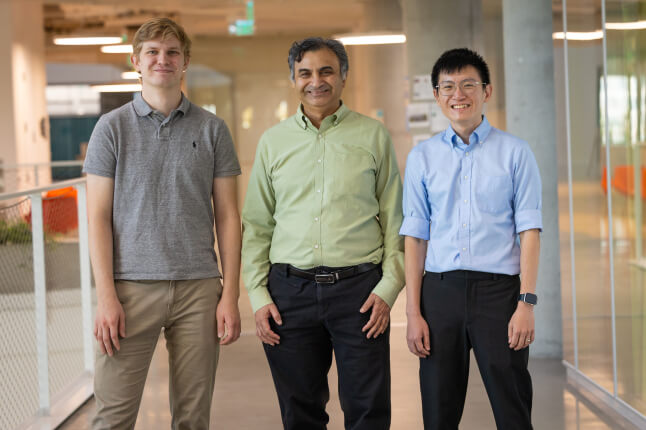
The device, a ring-shaped, “racetrack” quantum cascade laser, generates a specific type of light source called a frequency comb in the difficult-to-access mid-infrared region of the electromagnetic spectrum. It was developed in the lab of Federico Capasso, the Robert L. Wallace Professor of Applied Physics and Vinton Hayes Senior Research Fellow in Electrical Engineering, in collaboration with co-senior author Benedikt Schwarz and colleagues at TU Wien.
The research was co-led by first author Ted Letsou, a postdoctoral researcher in the Capasso group, and Johannes Fuchsberger, a graduate student at TU Wien, and is published in Optica.
Frequency combs — the subject of a modern Nobel prize and used today in countless high-precision optical measurement tools — are lasers that emits hundreds or thousands of colors of light that are perfectly, evenly spaced, hence “comb.” Making frequency combs in the mid-infrared wavelength range is foundational to modern gas-sensing applications because molecules like carbon dioxide and methane leave their strongest absorption signatures in this region.
But making such combs bright, stable, and compact is a perennial engineering challenge. Today, they are most often generated by conventional lasers that are sensitive to optical feedback and require bulky stabilizing equipment.
Inherently stable frequency combs
The new device from the Harvard team is different because it makes inherently stable frequency combs that don’t require any outside moving parts, paving the way for miniaturization. Based on the fundamental architecture of a quantum cascade laser, a precisely layered semiconductor laser first pioneered by Capasso and others, it is redesigned as an optical ring resonator in a racetrack shape. Light circulates around this loop at a rate of about 15 billion times per second.
A key innovation is how they force the laser to become a frequency comb. They connect metallic probes to the chip and drive the laser electrically with a radio-frequency signal that matches the light’s round-trip frequency, snapping the laser into a comb shape that’s locked to the electronic signal driving it.
“We’re effectively turning the laser on and off really quickly,” Letsou said. “And in doing so, you create this incredibly stable, broadband frequency comb.”
Dual-comb spectrometer applications
Ultimately, the new device could be used in a dual-comb spectrometer, a powerful but currently very complex instrument that typically occupies a meter-scale setup. This technology is used today to sensitively measure diffuse gases using two lasers with slightly different frequency spacings that are combined to interfere with each other. This produces a more easily measured set of radio-frequency tones.
Conventional semiconductor frequency combs used in dual-comb spectrometry are typically generated from straight bar lasers that emit in both directions. That symmetry makes them notoriously sensitive to optical feedback; stray reflections from mirrors, lenses, or even imperfect surfaces can destabilize the comb, forcing engineers to incorporate large optical isolators into their systems.
The Harvard team’s racetrack design solves that problem by being unidirectional; light circulates only clockwise or counterclockwise in the ring. Any reflected light that re‑enters the chip is forced to travel the opposite way and sees no gain, so it quickly dies out instead of wrecking the comb. This architecture was previously demonstrated by Capasso and colleagues to create other types of frequency combs, including solitons, or bright pulses of high-intensity light.
To prove the point, in experiments the team deliberately placed a small mirror in front of the chip to reflect as much light as possible straight back into the laser — an exaggerated level of feedback that would readily destroy a standard comb. But in the racetrack laser, the comb spectrum remained essentially unchanged.
By showing that their single racetrack laser can reliably produce a bright, electronically controlled, feedback‑immune comb, the new work clears a major hurdle for next-generation dual-comb spectrometry. Multiple racetrack lasers and couplers can, in principle, be patterned side‑by‑side on the same semiconductor chip, each driven by its own radio frequency signal, to form the two combs needed for the technology. The result could be compact sensors for greenhouse gas monitoring, industrial process monitoring, or even medical diagnostics like breath analysis.
“High-power ring laser frequency-modulated combs” was co-authored by Johannes Fuchsberger, Nikola Opacek, Dmitry Kazakov, and Paul Chevalier. Federal support came from the National Science Foundation under grant No. ECCS-2221715.
Topics: Applied Physics, Electrical & Computer Engineering, Materials Science & Mechanical Engineering, Optics / Photonics, Quantum Engineering, Research, Technology
Cutting-edge science delivered direct to your inbox.
Join the Harvard SEAS mailing list.
Scientist Profiles

Federico Capasso
Robert L. Wallace Professor of Applied Physics and Vinton Hayes Senior Research Fellow in Electrical Engineering
Press Contact
Anne J. Manning | amanning@seas.harvard.edu