News
Key Takeaways
- Harvard researchers have joined a Sandia National Laboratories-led project to create a physics-constrained AI foundation model for studying complex turbulent flows that are important to energy systems.
- The project is part of the Department of Energy Genesis Mission, a national initiative to integrate AI with supercomputing and scientific infrastructure.
The wakes of a ship, the supersonic movement of aircraft, and aerosols swirling in the atmosphere are all examples of complex turbulent flows – fluid motions that exhibit chaotic, unpredictable changes in velocity and pressure.
Researchers in the Harvard John A. Paulson School of Engineering and Applied Sciences (SEAS) are using artificial intelligence and large-scale simulations to make sense of even the most complex of turbulent flows, and to quantify the uncertainty inherent in those predictions.
As part of that effort, a SEAS team led by Petros Koumoutsakos, the Herbert S. Winokur, Jr. Professor of Computing in Science and Engineering at SEAS, has joined the Department of Energy-funded Genesis Mission, a national initiative to integrate AI with supercomputing and scientific infrastructure to improve the output and impact of American research and engineering.
In a project led by Sandia National Laboratories, researchers are creating a physics-constrained AI foundation model — a system trained on vast datasets that can be adapted to perform many tasks — for complex flows important to energy systems.
The model could be used to support research into combustion processes for emerging fuels like hydrogen, or atmospheric reconstruction for wind energy operations and improving understanding of how turbulence affects wind turbines. The research could also apply to aerosol modeling, including the movement and interactions of microscopic particles in the Earth’s atmosphere. Today, these systems are difficult and expensive to simulate in fine detail.
A physics-informed foundation model could be adapted to solve each of these problems, but to date, researchers have struggled to measure and characterize uncertainty in the forecasts of foundation models.
“To quantify uncertainty in a foundation model is a big open problem,” Koumoutsakos said. “How do you put the equations and the data together? That’s something that our Bayesian methodology is unique in doing.”
The project builds on MATEY, a foundation model for turbulence previously developed by researchers at Oak Ridge National Laboratory. The research team plans to combine this model with a physics-informed training approach called Bayesian Optimization of a Discrete Loss, or B-ODIL, led by Koumoutsakos. The resulting model should incorporate both large-scale data-driven modeling as well as known physics laws.
For Koumoutsakos, the work is part of a broader vision of AI for science: using artificial intelligence to understand and optimize real scientific and engineering systems. The larger Genesis Mission also builds on other ideas that Koumoutsakos pioneered, including multi-agent reinforcement-learning for turbulence modeling and the use of generative AI for forecasting turbulent flows.
Topics: AI / Machine Learning, Applied Computation, Applied Mathematics, Applied Physics, Climate, Computer Science, Electrical & Computer Engineering, Environment, Environmental Science & Engineering, Research, Technology
Cutting-edge science delivered direct to your inbox.
Join the Harvard SEAS mailing list.
Scientist Profiles
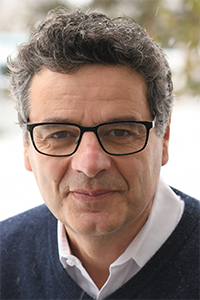
Petros Koumoutsakos
Herbert S. Winokur, Jr. Professor of Computing in Science and Engineering
Press Contact
Anne J. Manning | amanning@seas.harvard.edu