News
Key Takeaways
- Harvard researchers have built a device called a pico-calorimeter that directly measures heat signals from small groups of living cells.
- The device could lead to advances in bacterial growth monitoring or antibiotic resistance testing.
When living cells grow, divide, or respond to drugs, they give off tiny amounts of heat that offer information about what the cells are doing. But since these heat signals are so vanishingly small, they have been traditionally impossible to measure directly.
Researchers in the Harvard John A. Paulson School of Engineering and Applied Sciences (SEAS) have developed a calorimeter — a device that measures the heat transfer between a living system and its environment — that can detect metabolic heat signals on the order of 100 picowatts, or trillionths of a watt, in living cells. The device is the most sensitive of any comparable bio-calorimeter to date. The new “pico-calorimeter” can track the metabolism of small populations of bacteria in real time, as well as monitor how bacterial growth changes in response to different antibiotics.
The work is from the lab of Joost Vlassak, the Abbott and James Lawrence Professor of Materials Engineering, and was carried out by Harvard associate Juanjuan Zheng, a former postdoctoral researcher in Vlassak’s lab. The research is published in Proceedings of the National Academy of Sciences.
Directly measuring heat from cells
Biologists can often only measure cellular metabolism via indirect calorimetry, for example by measuring oxygen consumption or chemical byproducts. By contrast, the SEAS device measures heat itself.
“Heat is a direct measure for cellular metabolism,” Vlassak said. “As the cells are going about their business, we see very nice exponential growth, depending on the media.”
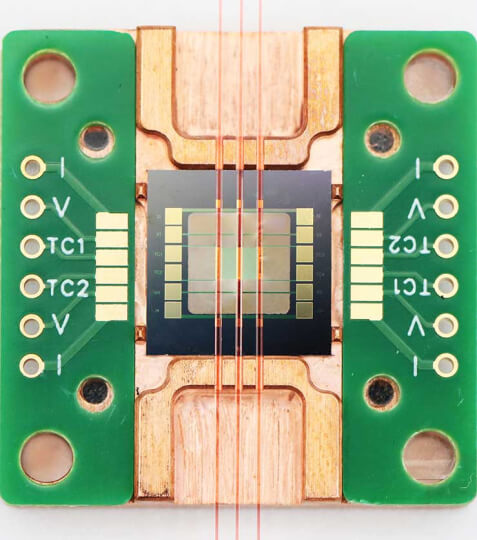
The pico-calorimeter assembled on a metal mount with a custom printed circuit board.
The sensor consists of three microscopic glass capillaries mounted on an extremely thin micromachined membrane. One capillary contains the biological sample in liquid growth medium, while the other two serve as references. As cells in the sample grow and consume nutrients, they release heat, creating minute temperature differences between the sample capillary and the references. A nearby thermopile, or heat-to-electricity converter, reads out the temperature differentials.
The capillaries and sensors are housed inside a vacuum chamber to keep them thermally isolated. This design boosts sensitivity by an order of magnitude compared with earlier generations of the pico-calorimeter developed by Vlassak and collaborators. Previous versions consisted of liquid droplets on a suspended membrane. The new vacuum-sealed, microfluidic design makes the new sensors easier to operate and more robust.
Bacterial growth demonstrations
To demonstrate the utility of the device, the team used the pico-calorimeter to track the growth of E. coli bacteria, starting with only 30-40 individual bacteria.
They also demonstrated the potential of their device as an antibiotic resistance probe by exploring calorimetric signal changes that occur when antibiotics are added to a sample of bacteria. In the paper, they report measurements of E. coli growth in the presences of three drugs with distinct mechanisms of action: chloramphenicol, rifampicin, and ampicillin.
By comparing heat traces with and without antibiotics at various concentrations, the team showed how the drugs alter metabolic activity. Because all the measurements are direct, they can detect changes long before standard culture-based methods.
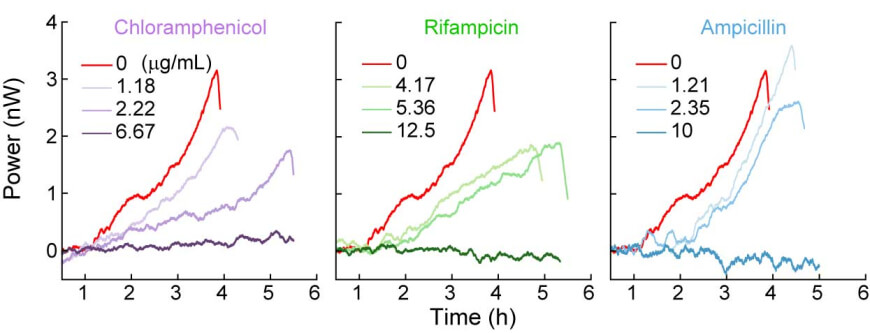
The researchers used the pico-calorimeter to measure heat flow from bacteria that were exposed to three types of antibiotics.
Another use case they envision is for sepsis, where sick patients might have only tens of bacteria per milliliter in their blood, Vlassak said. Because of its high sensitivity, the pico-calorimeter could, in principle, monitor metabolic activity and drug response of similarly small bacterial populations in just a few hours, instead of waiting days for large colonies to form.
“The most exciting part has been seeing people from many different kinds of research labs ask about our device,” Zheng said. “It’s very difficult to measure dynamic information from small living systems. With this platform, we can begin to monitor cell viability, growth rate, proliferation, and drug response in real time. More broadly, it gives us an early functional readout of what a biological system is doing - whether it is growing, stressed, responding to treatment, or changing its metabolic state.”
Two decades of pico-calorimetry research
The new device builds on roughly two decades of work on micro- and pico-calorimetry in the Vlassak group. After joing the lab in 2016, Zheng initially developed nano-calorimetry systems for studying phase transformations in thin-film shape memory alloys and metallic glasses. Over time, she began to work on ultra-sensitive calorimetry methods for biological applications, including measurements of metabolic heat in large cells and developing embryos.
Harvard’s Office of Technology Development has filed multiple patent applications on the device and its use in antimicrobial susceptibility testing. Zheng has co-founded a company out of the Vlassak lab to develop picocalorimetry-based tools that turn heat measurement into a practical, real-time, label-free functional readout for small biological samples, with potential applications in biological research, drug-response assays, and antimicrobial susceptibility testing. She is also an Activate Fellow, part of a prestigious fellowship program that supports deep-tech founders as they translate scientific breakthroughs into real-world impact. The work to advance the technology has also been supported by the Harvard GRID Accelerator.
The research was supported by the Harvard University MRSEC, funded by the National Science Foundation under grant No. DMR-2011754. The sensors were fabricated in part at the Harvard Center for Nanoscale Systems, a member of the National Nanotechnology Coordinated Infrastructure Network and supported by the NSF under award No. ECCS-2025158.
Topics: Bioengineering, Materials Science & Mechanical Engineering, Research, Technology
Cutting-edge science delivered direct to your inbox.
Join the Harvard SEAS mailing list.
Scientist Profiles

Joost J. Vlassak
Abbott and James Lawrence Professor of Materials Engineering
Press Contact
Anne J. Manning | amanning@seas.harvard.edu
Related News

Applying AI to Accelerate Design, Test and Manufacture
University of Washington Mechanical Engineering
AI / Machine Learning, Applied Physics, Computer Science, Electrical & Computer Engineering, Materials Science & Mechanical Engineering, Meet Our Faculty, Research, Technology