News

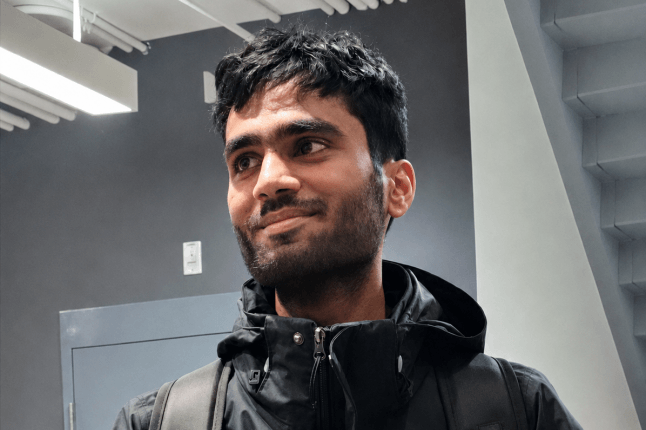
For her senior capstone project, Kiyana Gallagher developed a hydrogel that helps the heart itself after a heart attack (Eliza Grinnell/SEAS)
Engineering Design Projects (ES 100), the capstone course at the Harvard John A. Paulson School of Engineering and Applied Sciences (SEAS), challenges seniors to engineer a creative solution to a real-world problem.
Hydrogel-Mediated Delivery of Circular RNA for Enhanced Cardiac Regeneration Post-Myocardial Infarction
Kiyana Gallagher, S.B. ‘26, Bioengineering
Advisor: Miao Cui
• Please give a brief summary of your project.
Cardiovascular disease is the leading cause of death worldwide, accounting for over 17.9 million deaths annually according to the World Health Organization. A major contributor to this mortality is myocardial infarction (MI), or heart attack, which occurs when blood flow to a portion of the heart is obstructed. This ischemic event leads to the death of cardiomyocytes, the contractile cells responsible for pumping blood. Because adult human cardiomyocytes have very limited regenerative capacity, the heart is unable to replace the lost cells. Instead, the damaged tissue is repaired through fibrosis, resulting in the formation of scar tissue that compromises cardiac function and can ultimately lead to heart failure. My project develops a targeted, non-viral gene delivery system designed to help the heart repair itself after injury. I engineered an injectable hydrogel that delivers circular RNA (circRNA) encoding regenerative transcription factors directly to the damaged region. The hydrogel keeps the therapy localized and releases it gradually over several days, enabling sustained activation of regenerative pathways in surviving heart cells.
• What real-world challenge does your project address?
While researchers have identified transcription factors and pathways that can promote heart repair, there is currently no clinically effective way to deliver these signals safely, locally, and for the right duration in patients after a heart attack. Many delivery systems struggle to target the damaged heart tissue specifically, leading to off-target effects in other organs. My project’s approach is designed to keep the therapy at the site of injury and release it over the critical window when regeneration is most possible.
• How did you come up with this idea for your final project?
I have always been interested in the heart, which led me to join a cardiology lab during my sophomore year. In my early work there, I focused on studying the biological side of cardiac regeneration, specifically, identifying and understanding the signaling pathways and transcription factors that enable heart cells to repair themselves. I became particularly interested in the engineering side of the problem, designing a system that could translate these biological insights into a practical therapy.
• What was the timeline of your project?
The first of three phases focused on designing and optimizing the hydrogel system and took the largest portion of time. The second phase centered on incorporating circular RNA into the hydrogel. The final phase involved in vitro testing and validation, measuring how the circRNA was released over time, and determining how effectively cells could take it up. Overall, the timeline reflects a progression from material design, to integration of the therapeutic component, to biological validation of the full system.
• What part of the project proved the most challenging?
A main challenge was bridging the gap between biological insight and engineering design. While there is strong evidence identifying transcription factors that promote cardiac regeneration, there is less guidance on how to deliver them effectively in a controlled and clinically feasible way. This meant that many design decisions, such as selecting circRNA as the platform and choosing a hydrogel-based delivery system, had to be made by integrating knowledge across disciplines and evaluating incomplete or emerging data. Another challenge was designing a system that could simultaneously satisfy multiple, often competing requirements.
• What part of the project did you enjoy the most?
The part I enjoyed most was bringing together ideas from different fields to design a complete solution. I started with a biological question, how the heart can regenerate, and then worked toward an engineering approach to actually deliver those regenerative signals. Connecting what I had learned in the lab about transcription factors with biomaterials design and gene delivery made the project feel especially meaningful and interdisciplinary. Overall, the most fulfilling part was moving beyond just understanding the problem to actually proposing a tangible solution that could, in the future, contribute to real-world therapies for heart disease.
• What did you learn, or skills did you gain, through this project?
Through this project, I developed both technical and conceptual skills at the intersection of bioengineering, materials science, and gene therapy. On the technical side, I gained experience in designing biomaterial-based delivery systems, including how to tune hydrogel properties like stiffness, crosslinking density, and degradation to control therapeutic release. I also learned how to think about nucleic acid platforms and how their properties influence stability, expression, and clinical feasibility. Equally important, I strengthened my ability to approach complex biological problems from an engineering perspective, and critically evaluate scientific literature and integrate findings across disciplines to inform my design. Beyond technical skills, this project helped me become more comfortable working in an open-ended design space where there is no single “right” answer. It required iterative thinking, balancing trade-offs, and clearly communicating both the rationale and limitations of my approach, skills that are essential for tackling real-world problems in biomedical engineering.
Topics: Academics, Bioengineering, Health / Medicine
Cutting-edge science delivered direct to your inbox.
Join the Harvard SEAS mailing list.
Press Contact
Matt Goisman | mgoisman@g.harvard.edu