News
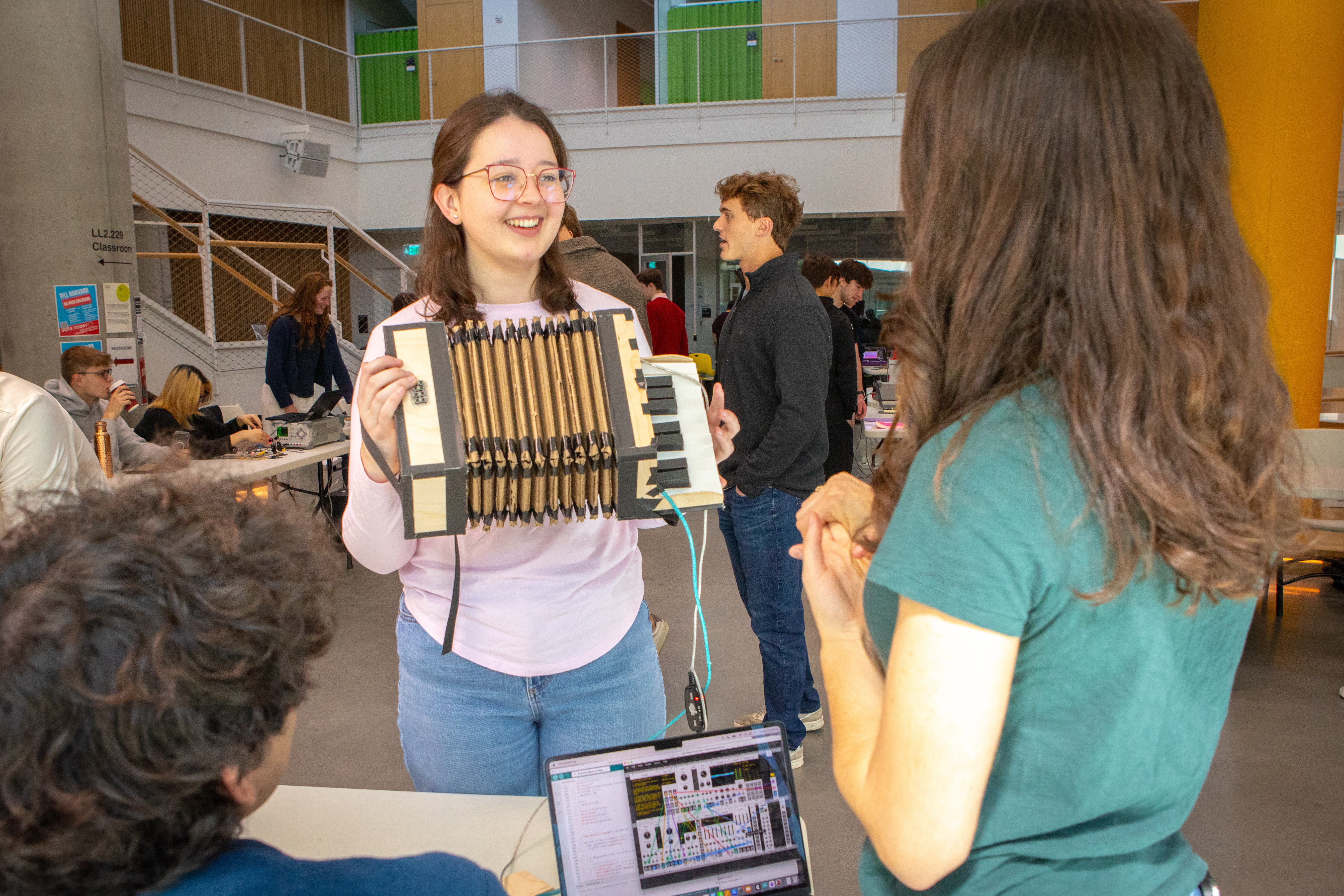
A Harvard student plays "Accordion to Plan," by Mike Thomas and Leyna Blume (Eliza Grinnell/SEAS)
A distance tracker, an algorithm, pressure sensors — as students in “GENED1080” learned, anything can become a musical instrument with a bit of engineering know-how.
“Creativity is the core of the class,” said instructor Robert Wood, Harry Lewis and Marlyn McGrath Professor of Engineering and Applied Sciences. “Students come with all sorts of backgrounds and interests and things they’ve been exposed to, and I see that come through in their projects. Somebody might already play an instrument and want to go deeper, but they might also take something else from their lives, like a video game or a sport, and then want to instrument that. The course is flexible enough to hopefully allow them to do that.”
The annual festival for “GENED1080: How Music Works: Engineering the Acoustical World” is the culmination of a course that brings engineering and non-engineering concentrators alike to the Harvard John. A Paulson School of Engineering and Applied Sciences (SEAS). Taking place at the Science & Engineering Complex, students filled the lowest atrium with a mix of electronic sounds, percussion and acoustic music.
“Coming from an electrical engineering background, most of my labs have been focused on replicating predefined circuits,” said Grace Hur, a sophomore electrical engineering concentrator. “I really enjoyed the creative component of this course, where we could get our hands dirty with actually prototyping things that we wanted to make.”
Hur and Cassidy Crabb, a sophomore studying economics and theater, dance and media, co-created “Kart-Tune.” They took a white plastic steering wheel game controller used in the “Mario Kart” video game series, then programmed it to play a range of pitches depending on how the wheel is spun.
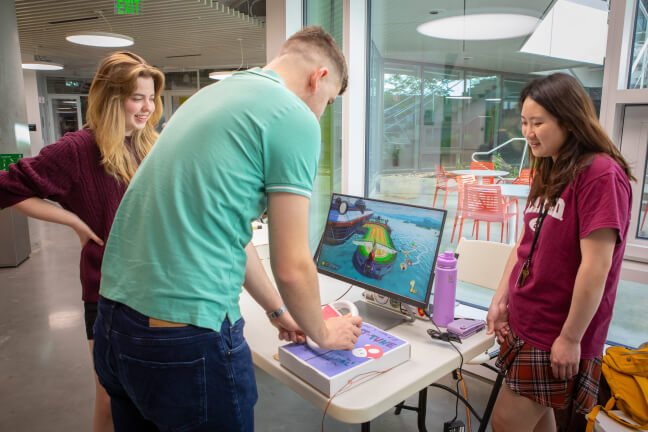
Cassidy Crabb and Grace Hur demonstrate their "Kart-Tune" project (Eliza Grinnell/SEAS)
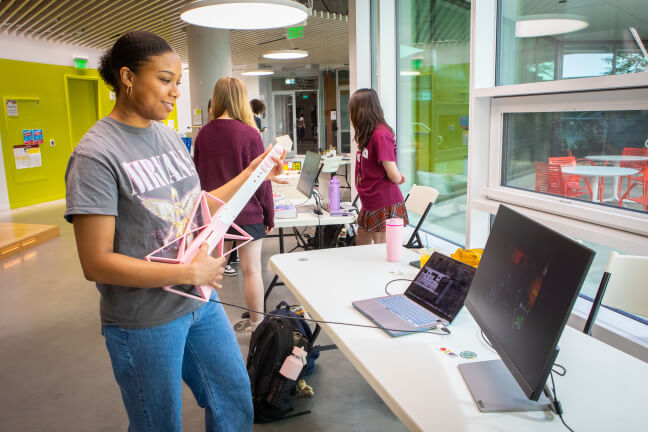
Madison Hussey demonstrates "The Guitar Heroes" (Eliza Grinnell/SEAS)
They weren’t the only students inspired by video games. Seniors Madison Hussey and Layla Dawit and junior Diya Gheewala 3D-printed and programmed a guitar-shaped controller designed to mimic those used in the “Guitar Hero” series. The trio were honored with the “Most Interactive Project” award at the end of the event.
“I’d never seen a circuit before, but as senior spring came around, I decided to take the opportunity to try out other courses that interested me,” said Hussey, a statistics and economics student. “This course ended up being one of my favorite classes at Harvard. It really allowed me to be creative and try new things.”
While many students devised electronic instruments, others chose to go with traditional wooden ones. Sophomore Saleh Yassin and junior Aram Bagdasarian crafted a kanun, which is a wooden instrument in which metal strings are attached along a trapezoidal wooden box to create a harp-like instrument similar to a zither. Calling their project “Mesopotamian Sounds,” instruments like this are part of Yassin’s Arabic and Bagdasarian’s Armenian cultures.
“As a kid I used to play the guitar, and I was always interested in the mechanics behind it,” Bagdasarian said. “I didn’t have access to a lot of instruments, and I was always passionate about percussion. When I started playing drums, I’d grab utensils from our kitchen. That motivated me to understand the acoustics mechanics behind building an actual instrument, because I’ve always tried to improvise with limited resources.”
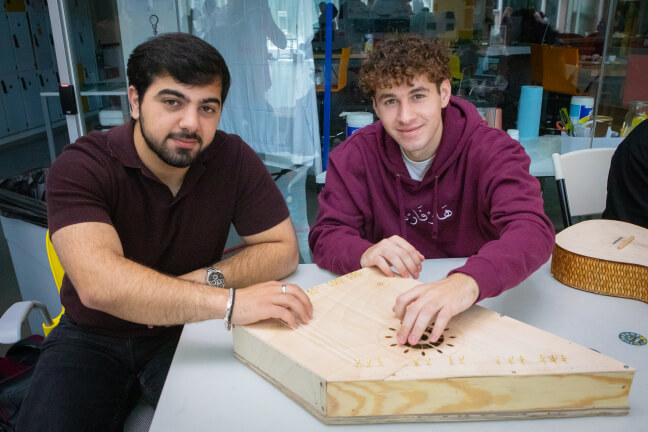
"Mesopotamian Sounds," by Saleh Yassin and Aram Bagdasarian (Eliza Grinnell/SEAS)
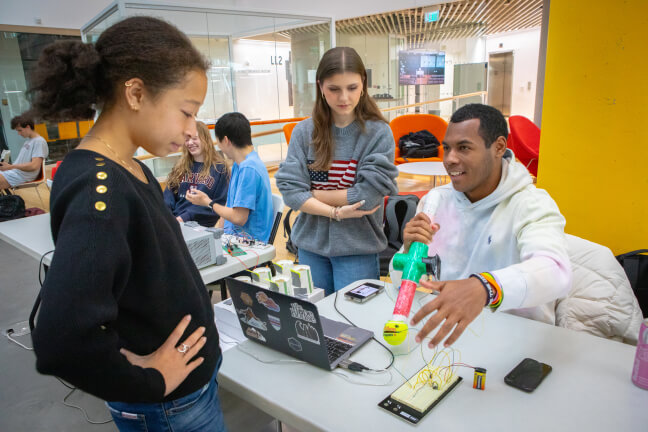
Mekhi Moore and Arba Kamberi show off their "Otamabro" (Eliza Grinnell/SEAS)
Senior Mekhi Moore and sisters Arba and Dea Kamberi took their inspiration from a Japanese instrument called an otamatone, an electronic instrument shaped like a musical note whose spherical bottom is sculpted with openings resembling eyes and a smiling mouth. Their version, called the “Otamabro,” replaces the normal haptic system with a potentiometer, which is a resistor that can be manually adjusted to change the pitch of the frequencies emitted from the mouth.
“I’m personally obsessed with music, but I’d never quite learned how to combine music, physics and engineering,” said Moore, an astrophysics concentrator. “This class seemed like an interesting way for me to apply what I’ve learned throughout college to something I really enjoy.”
The SEC itself became a source of inspiration for some. Senior economics students Said El Kadi and Zach Abrams and junior physics student Vivien Henz enjoyed routinely walking past the “Harvard Time Capsule,” a trio of wall panels whose discs change to mirror the movements of people walking in front of them. For their project, the three students created “Airkeys,” in which they programmed a laptop camera to interpret finger movements as if they were playing piano keys.
“We wanted something that similarly felt kinetic and reactive that you didn’t need to touch to be able to engage with meaningfully,” El Kadi said.
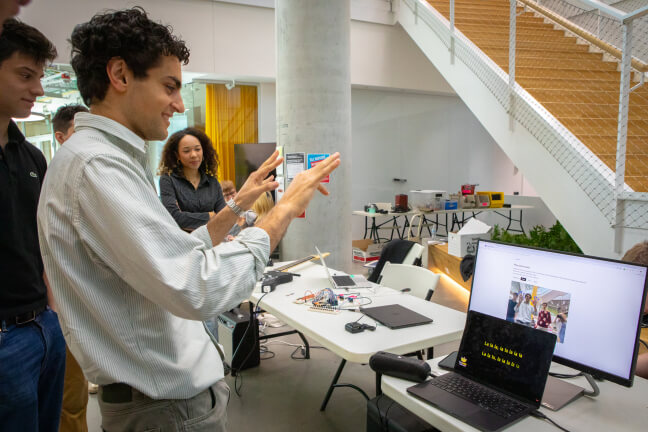
Said El Kadi plays his "Airkeys" project (Eliza Grinnell/SEAS)
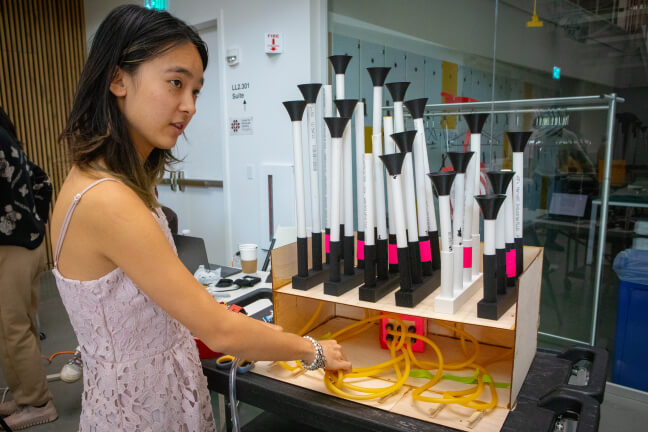
Ellen Pan demonstrates her "Pipe Organ" project (Eliza Grinnell/SEAS)
Junior Ellen Pan took GE1080 as a change from the theoretical coursework typical of her applied math concentration. She teamed up with junior bioengineering student Ishika Nag and junior neuroscience and chemistry student Erin Keita to create the “Pipe Organ,” which uses clamps to control airflow into PVC pipes similar to how air flows through the traditional metallic or wooden pipes of real organs.
“I wanted to do something practical,” Keita said. “I’m far from an engineer, so I thought what better way to try it out than to take this GenEd class. I was really pleasantly surprised by everything I was able to build. It’s crazy that I sketched something on a piece of paper, and it came out like this.”
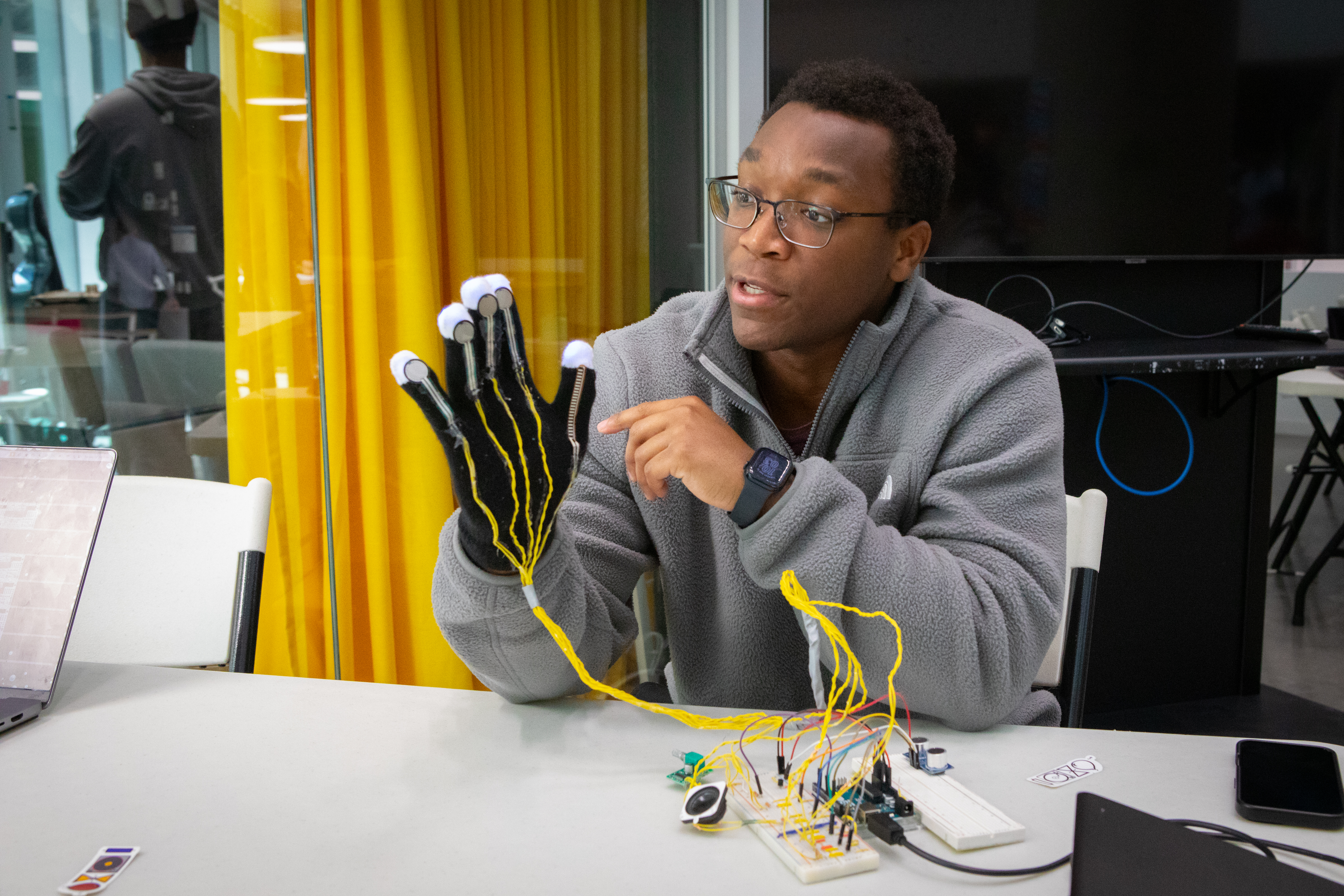
Tinaye Ngorima demonstrates the "Aerotone" (Eliza Grinnell/SEAS)
Topics: Academics, Electrical & Computer Engineering, Materials Science & Mechanical Engineering
Cutting-edge science delivered direct to your inbox.
Join the Harvard SEAS mailing list.
Press Contact
Matt Goisman | mgoisman@g.harvard.edu
Related News

Applying AI to Accelerate Design, Test and Manufacture
University of Washington Mechanical Engineering
AI / Machine Learning, Applied Physics, Computer Science, Electrical & Computer Engineering, Materials Science & Mechanical Engineering, Meet Our Faculty, Research, Technology