News
Engineering Design Projects (ES 100), the capstone course at the Harvard John A. Paulson School of Engineering and Applied Sciences (SEAS), challenges seniors to engineer a creative solution to a real-world problem.
Orbital Locker Satellite Vibration Testing and Mechanical Design
Michael Kuhl, S.B. '26, Mechanical Engineering
Advisor: James Dingley
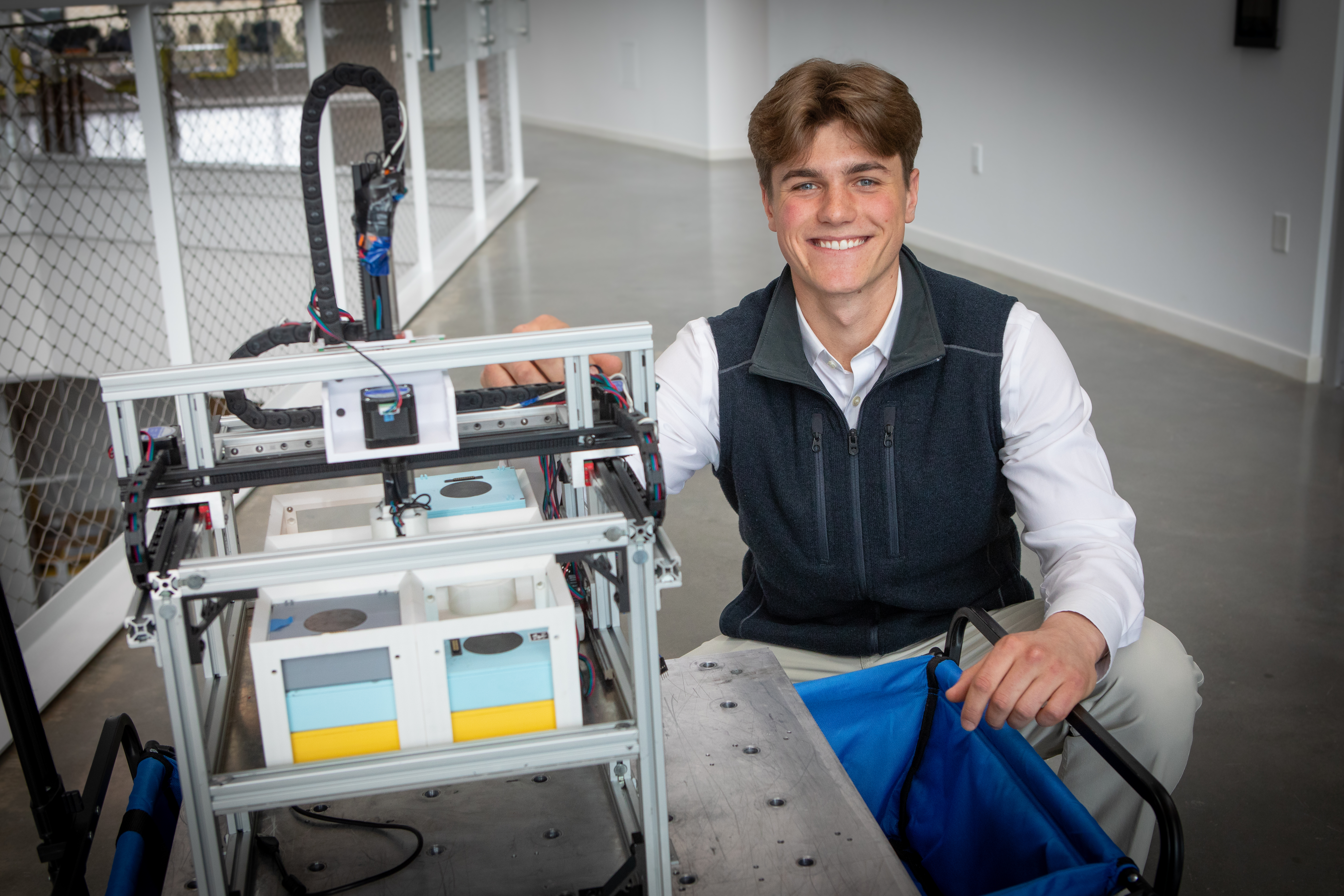
For his senior capstone project, Michael Kuhl designed a satellite payload capable of assembling other satellites in space (Eliza Grinnell/SEAS)
• Please give a brief summary of your project.
I built a locker mechanism, which is a satellite payload that will go to space, and then has the capability to assemble other satellites while in orbit. It houses these modules that can come together and make up cube satellites, which are then deployed and operate as independent satellites on orbit.
• How did you come up with this idea for your final project?
This is a project that's ongoing at MIT based out of one of their laboratories called the Space Telecommunications, Astronomy and Radiation Laboratory. The principal investigator is Kerri Cahoy, and my advisor is James Dingley. They were great at letting me come on board and look at whether this payload can survive the conditions of launch. This is an awesome project that's ongoing, but we need to get it to space, and so we need to make sure it can survive being on a rocket and going through the treacherous conditions of launch.
• What part of the project did you enjoy the most?
It's a daunting task, finishing a thesis and this ES 100 project. But I had an incredible network of people supporting me, and being able to work on something that may go to space at some point is very exciting, and there's a lot of purpose behind it. It was a great experience overall.
Topics: Academics, Materials Science & Mechanical Engineering
Cutting-edge science delivered direct to your inbox.
Join the Harvard SEAS mailing list.
Press Contact
Matt Goisman | mgoisman@g.harvard.edu
Related News

Applying AI to Accelerate Design, Test and Manufacture
University of Washington Mechanical Engineering
AI / Machine Learning, Applied Physics, Computer Science, Electrical & Computer Engineering, Materials Science & Mechanical Engineering, Meet Our Faculty, Research, Technology