News
Key Takeaways
- Harvard’s Visual Computing Group developed BRIDGE, a simulation system that converts standard standing-basketball footage into realistic wheelchair-basketball videos.
- BRIDGE uses an “embodiment-aware” reconstruction pipeline that tracks players and the ball in 3D, then remaps head, trunk, and wheelchair base movements.
A Harvard-led computer science study that addresses barriers in sports training for athletes with disabilities was recently honored with a Best Paper Award at the ACM Conference on Human Factors in Computing Systems (CHI), the premier venue for human-computer interaction research.
A research team that includes senior author Hanspeter Pfister, the An Wang Professor of Computer Science in the John A. Paulson School of Engineering and Applied Sciences (SEAS), developed BRIDGE, a simulation technology that reinterprets traditional non-disabled basketball footage into realistic wheelchair basketball video representations. The system is designed to give para-athletes and coaches access to video analysis resources that are commonplace in non-disabled sports but are rare in parasports.
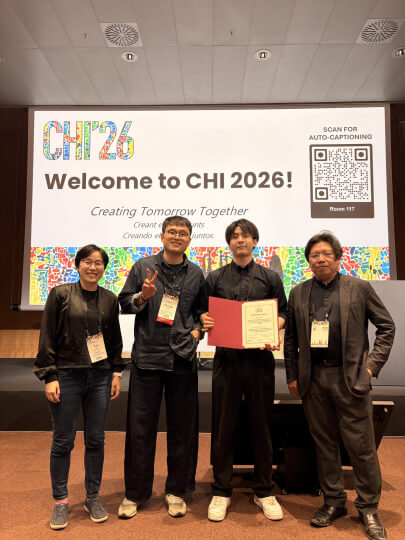
The Harvard team at CHI 2026.
The paper’s co-lead authors were Chunggi Lee, a Ph.D. student in Harvard’s Visual Computing Group, and Hayato Saiki, a former visiting scholar from University of Tsukuba.
Since the Visual Computing Group has long worked on sport-viewing and tracking tools, explained Lee, they have noticed how such systems quietly assume a non-disabled body as the default user. “We were motivated to expand our research to inclusive sports analytics and accessible tools,” Lee said.
With a connection to the Japanese national basketball team facilitated by Saiki, the researchers set out to ground their research into day-to-day practice. “Through our collaboration with the team, we realized that the main bottleneck was not tactical understanding itself, but the constant effort needed to translate stand‑up footage into wheelchair play,” Lee said. “What made it compelling was hearing national wheelchair basketball team players describe how much cognitive effort they spend mentally translating non-disabled footage.”
BRIDGE is designed with this gap in mind. It employs a reconstruction pipeline that detects and tracks players and the ball from broadcast video to generate 3D play sequences. It then applies an “embodiment-aware” visualization framework that decomposes and remaps head, trunk, and wheelchair base orientations. This layered mapping conveys where a player is looking, what they intend to do, and how they move, all within the constraints of wheelchair basketball.
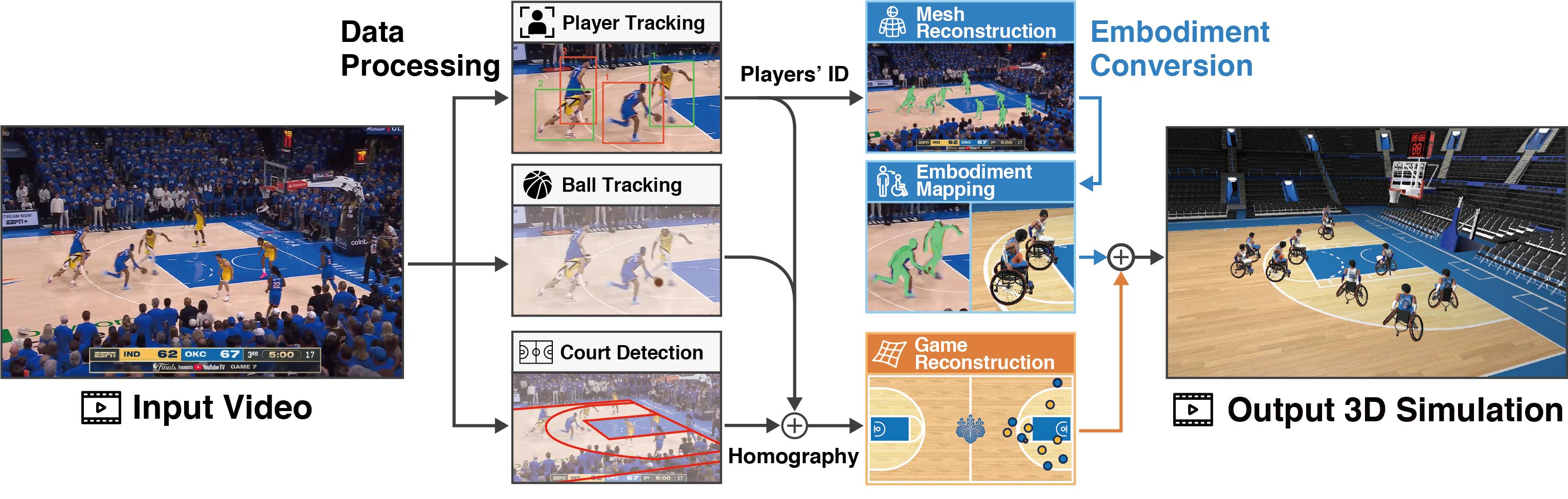
An overview of the embodiment mapping and game reconstruction system.
In controlled studies with 20 participants, including 10 Japanese national wheelchair basketball team players and 10 non-elite players, BRIDGE significantly improved how natural player postures appeared and made tactical intentions easier to understand. Participants reported that the system more accurately reflected players’ functional capabilities compared with non-disabled video resources.
BRIDGE showed the team that even relatively simple embodiment‑aware transformations, like explicitly modeling trunk and head mobility and functional classes, can preserve tactical content, Lee said. “This experience taught us to ground visualization and reconstruction methods in the real constraints of specific athlete communities, and to treat bodily differences not as edge cases, but as core design parameters for more inclusive tactical learning tools.”
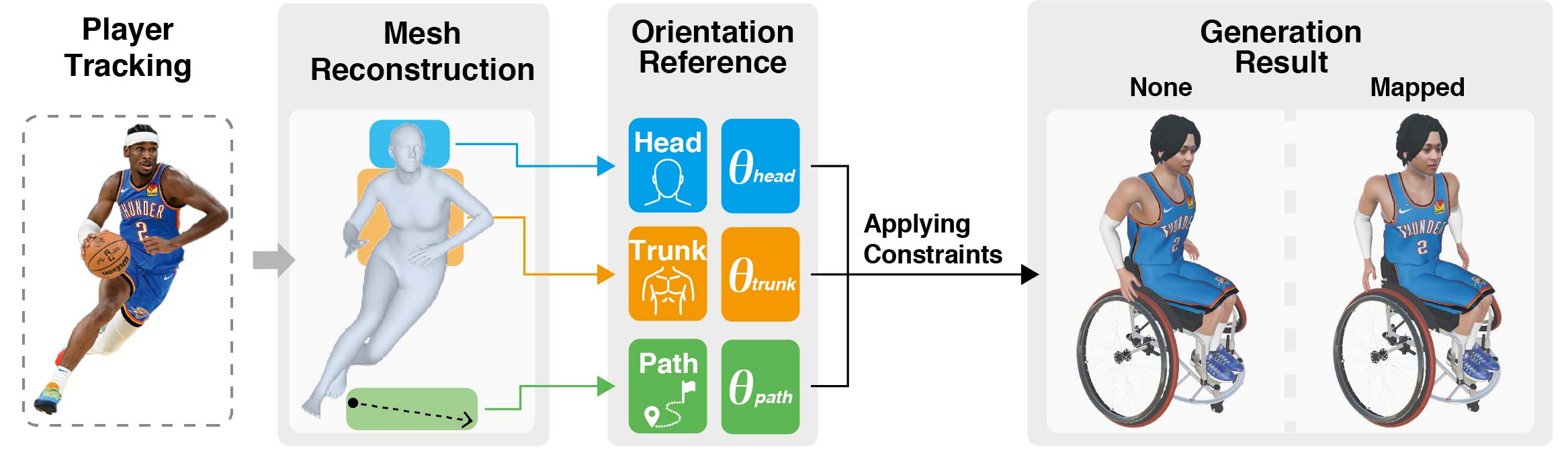
Overview of the embodiment-aware orientation mapping process.
Looking forward, the team hopes to extend their idea of “embodiment transformation” beyond wheelchair sports; for example, by incorporating augmented or virtual reality and artificial intelligence to support other parasports, rehabilitation, or even youth or older athletes, Lee said.
“BRIDGE: Borderless Reconfiguration for Inclusive and Diverse Gameplay Experience Via Embodiment Transformation” was further co-authored by Hikari Takahashi, Tica Lin, Hidetada Kishi, Kaori Tachibana, Yasuhiro Suzuki, and Kenji Suzuki.
Pfister is a member of Center for Human-driven AI Research and Methods (CHARM), a multi-faculty center at SEAS. The group focuses on human-AI interaction design and computational methods to create AI tools that put people first; expand human capability; and leave people better prepared for the next challenge.
"The training tools that elite athletes rely on were quietly designed around one kind of body. BRIDGE shows we can do better," Pfister said. "By combining computer vision, AI, and eventually augmented reality, we can build systems that adapt to the athlete rather than asking the athlete to adapt to the system. That is what inclusive technology should look like, and it is the direction we are pushing at CHARM."
The work was supported by National Science Foundation grant No. CRCNS-2309041 and the Harvard Data Science Initiative Trust in Science Fund Award.
Topics: AI / Machine Learning, Applied Mathematics, Research
Cutting-edge science delivered direct to your inbox.
Join the Harvard SEAS mailing list.
Scientist Profiles

Hanspeter Pfister
An Wang Professor of Computer Science
Press Contact
Anne J. Manning | amanning@seas.harvard.edu