Cambridge
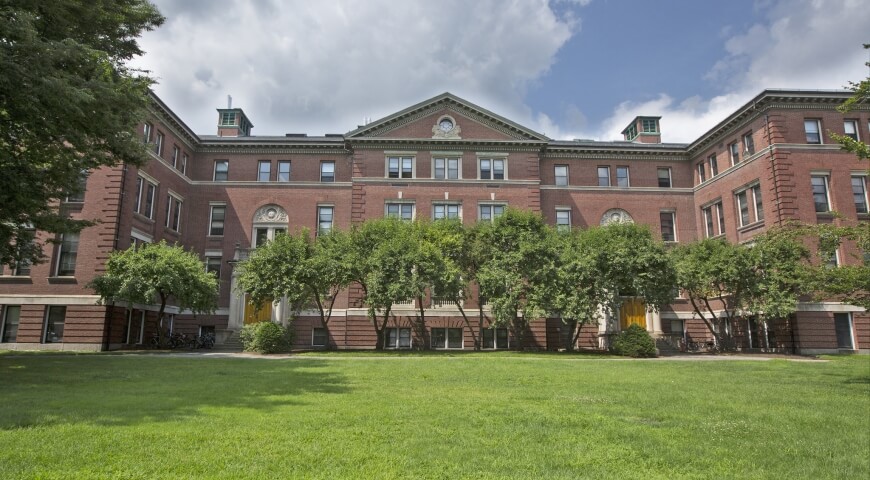
Harvard Engineering traces its Cambridge roots to the establishment of the Lawrence Scientific School in 1847, which laid the foundation for what is now the Harvard John A. Paulson School of Engineering and Applied Sciences (SEAS), with facilities located both along Oxford Street in Cambridge and Western Avenue in Allston.
Gordon McKay Laboratory of Applied Science
9 Oxford Street
Built in 1953 by Architect Shepley, Bullfinch, Richardson, and Abbott
The Gordon McKay Laboratory of Applied Science (named after donor and inventor Gordon McKay) contains laboratories, faculty offices, and graduate student spaces supporting research and teaching in Materials Science and Mechanical Engineering, and related interdisciplinary areas.
The five-story building is densely occupied, with labs and offices and includes multiple renovated, energy-efficient laboratory spaces and is physically connected to the Laboratory for Integrated Science and Engineering (LISE), enabling shared research infrastructure.
Cruft Laboratory
19A Oxford Street
Built in 1915 by architects E. J. A. Duquesne and H. L. Warren
Cruft Laboratory, originally known as the Cruft High Tension Laboratory, was constructed to support early research in antennas and electrical storage technologies. During World War II, the building played a significant role in radar research and is widely recognized as one of the earliest sites of federally sponsored scientific research conducted at a U.S. institution of higher education. Today, Cruft continues to support a mix of classroom instruction, teaching and research laboratories, faculty offices, administrative functions, and graduate student space serving both engineering and physics–affiliated work.
The building houses Applied Physics–affiliated research groups alongside programs in Environmental Science and Engineering, and Materials Science and Mechanical Engineering, as well as SEAS administrative and staff offices.
Cruft is physically connected to Pierce Hall via the Van Vleck Bridge at the second and third floors, which contains office space on both levels, although the floor elevations between the two buildings do not align. The laboratory also connects to the Laboratory for Integrated Science and Engineering (LISE) at the third floor and shares its western wall with Lyman Laboratory.
Pierce Hall
29 Oxford Street
Built in 1901 by architects Shaw and Hunnewell
Built in 1901, Pierce Hall is one of the oldest buildings on Oxford Street and serves as a central hub of academic and administrative activity within the Harvard John A. Paulson School of Engineering and Applied Sciences. The building was originally constructed to support the early expansion of engineering education in the twentieth century, with a particular emphasis on drafting and design—an origin still evident in the skylit third floor, which now houses flexible-use teaching spaces, including the Stephanie F. Connaughton Room.
Today, Pierce Hall accommodates a combination of classrooms, teaching and research laboratories, faculty offices, student and research staff offices, and administrative functions. The building houses SEAS administrative offices alongside academic areas including Applied Mathematics, Environmental Science and Engineering, and Materials Science and Mechanical Engineering.
Pierce Hall is physically connected to both Cruft Laboratory and the Maxwell Dworkin Laboratory by enclosed bridges, facilitating circulation and collaboration across the SEAS campus. The building is set back from Oxford Street and faces Holmes Field, establishing two primary façades: a formal street-facing elevation and a campus-facing elevation oriented toward Holmes Field and the neighboring Harvard Law School.
Maxwell Dworkin
33 Oxford Street
Built in 1999 by architect Payette
Completed in 1999, the Maxwell Dworkin Laboratory was named after the mothers of its principal donors, William H. Gates III and Steven A. Ballmer (both Class of 1977). The building was designed to house the expanding needs of Computer Science and Electrical Engineering, as well as associated teaching and administrative functions.
Today, Maxwell Dworkin accommodates classrooms, teaching laboratories, faculty offices, graduate student areas, and SEAS administrative offices. In addition to its primary role supporting Computer Science and Electrical Engineering, the building includes Applied Mathematics offices and shared instructional spaces that serve students across SEAS. The term “Laboratory” in the building’s name reflects its lineage as the successor to the former Aiken Laboratory.
Engineering Sciences Lab
58 Oxford Street
Built in 1964 by architect Minoru Yamasaki
The Engineering Sciences Laboratory (ESL), located at the northern end of the SEAS campus, was originally conceived as a high-temperature gas laboratory. The building was designed with exceptional flexibility for experimental research, including integrated ceiling and wall chases that allowed for extensive piping and mechanical systems.
Following a major renovation, ESL now supports laboratory-intensive research and teaching, particularly in Bioengineering and Environmental Science and Engineering, along with interdisciplinary research activities.
ESL’s precast concrete system and restrained modernist design distinguish it architecturally from the surrounding historic buildings while underscoring its original experimental mission and continued research focus.
Laboratory for Integrated Science and Engineering (LISE)
15 Oxford Street
Built by architect Rafael Moneo
The Laboratory for Integrated Science and Engineering (LISE) is a Harvard University–wide shared research facility that supports advanced interdisciplinary work, particularly in nanoscale science and engineering. LISE houses research laboratories, faculty offices, administrative space, and the Center for Nanoscale Systems.
Approximately one-third of the building is above ground, while a three-level basement contains a shared cleanroom, materials synthesis facilities, and advanced microscopy suites operated by the Center for Nanoscale Systems. LISE is physically connected to Cruft Laboratory, Gordon McKay Laboratory, and the Harvard Science Center, enabling close integration of research activities across multiple departments and disciplines.
Northwest Building
52 Oxford Street
Built in 2008 by architects Skidmore, Owings, and Merrill
The Northwest Building, located just north of the Harvard Museum of Natural History, is a large interdisciplinary academic and research facility shared by SEAS and the Faculty of Arts and Sciences. The building houses laboratories, classrooms, offices, and shared support spaces for a wide range of scientific fields.
SEAS-dedicated spaces within the Northwest Building include administrative offices and academic and research areas serving Bioengineering, Environmental Science and Engineering, and Materials Science and Mechanical Engineering. Other tenants include research groups in neuroscience, systems biology, and genomics, reinforcing the building’s interdisciplinary character.