News
Engineering Design Projects (ES 100), the capstone course at the Harvard John A. Paulson School of Engineering and Applied Sciences (SEAS), challenges seniors to engineer a creative solution to a real-world problem.
Morphing Aerospace Composites: A Mechanical Approach to Flow Control for STOL (Short Takeoff and Landing) Vehicles
Finn Seyffer, S.B. ‘26, Mechanical Engineering
Advisor: Mathew Grasinger
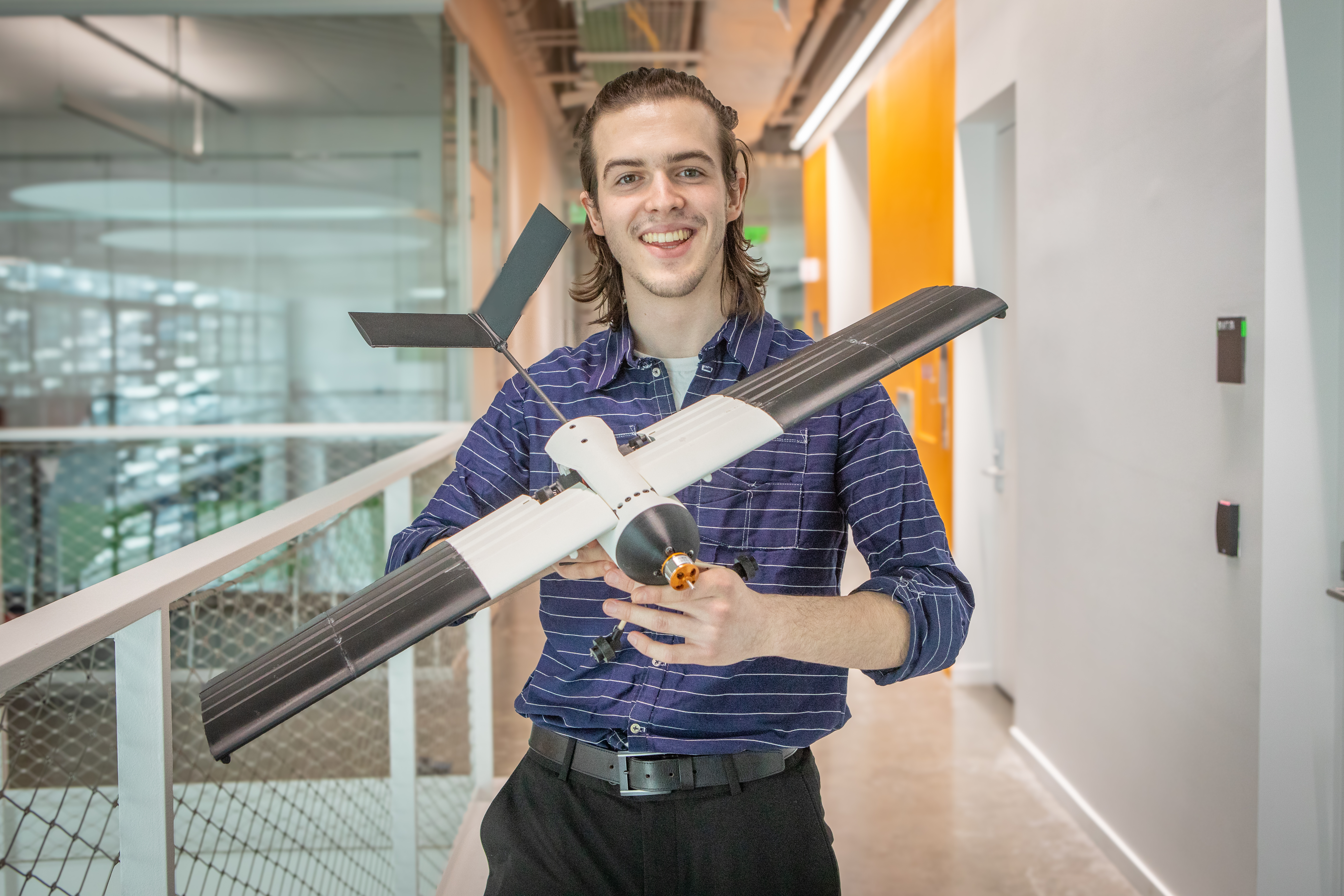
For his senior capstone project, Finn Seyffer developed an approach for optimizing flight for fixed-wing aircraft (Eliza Grinnell/SEAS)
• Please give a brief summary of your project.
I've worked on a model for short takeoff and landing aircraft which implements flow control. I am trying to enable urban air mobility – getting people off of the roads, off of infrastructure, utilizing short takeoffs to use the air, connecting cities and rural environments. Specifically, by inducing gaps within the wing as we increase its angle, we can allow air passing through the bottom to pass over the top of the fixed-wing aircraft – reducing detachment of turbulent flow at the back of the wing. This lets us fly at a slower speed, landing slower with fewer feet of infrastructure.
• How did you come up with this idea for your final project?
This project was mostly selected due to biomimicry. I'm particularly interested in avian-based design, and the flow control method used here very much resembles feathers and how they allow air to pass through, as well as some historical designs from early aerospace engineers.
• What part of the project proved the most challenging?
Most frequently when I work on a project like this, it's a group project, and so I'm very used to the intercommunication. I'm used to the scheduling, the planning. However, working between agencies was a new experience for me. So being advised by a research laboratory and testing in a different location, there was much more lead time, much more precision of detail necessary in communication, and that was probably a new experience for me.
• What part of the project did you enjoy the most?
One thing which I did discover at the very end of developing this project is that nearly this exact profile was developed concurrently by two separate people between 1917 and 1919. However, given that we can now electrify our aircrafts, I can make an active version rather than just a passive slotted version. So in a way, it's an evolution of an old craft.
Topics: Academics, Materials Science & Mechanical Engineering
Cutting-edge science delivered direct to your inbox.
Join the Harvard SEAS mailing list.
Press Contact
Matt Goisman | mgoisman@g.harvard.edu