News
Civil discourse is in crisis. Could artificial intelligence help?
A Harvard-led research team is betting on it. They’re building an advanced, AI-supported online platform that allows people across the political spectrum to come together and actually hear each other, rather than shout from their echo chambers.
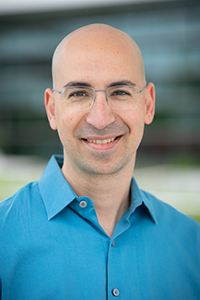
Ariel Procaccia
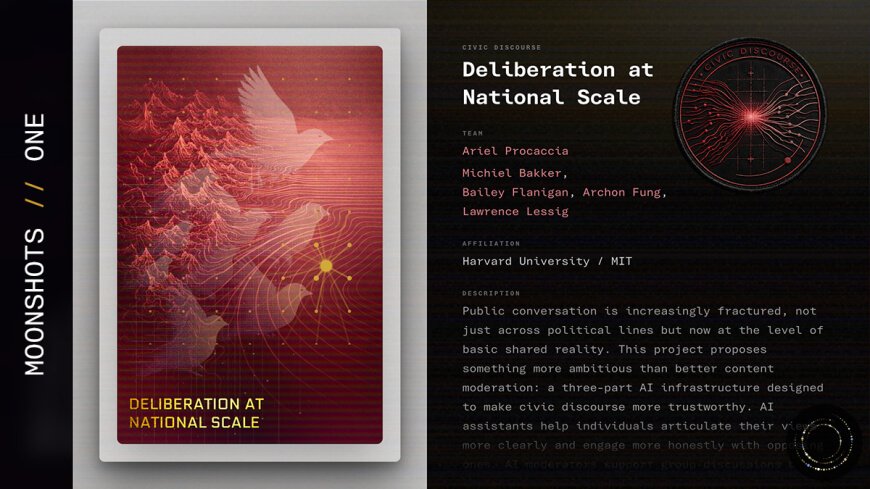
If it sounds ambitious, that’s the point. Laude Institute, a nonprofit research organization that supports the development of big ideas grounded in computer science and technology, has awarded a “Moonshot” seed grant to a team led by Ariel Procaccia, the Alfred and Rebecca Lin Professor of Computer Science in the Harvard John A. Paulson School of Engineering and Applied Sciences (SEAS).
The inaugural Moonshot awards are “ambitious research swings at real, hard problems” in which advances in AI can make a “species-level difference” in areas ranging from healthcare to civic engagement. The Harvard-led team supported in this initial seed round, with a chance to compete for a further $10 million to scale the work, includes Michiel Bakker and Bailey Flanagan from Massachusetts Institute of Technology; Archon Fung at the Harvard Kennedy School; and Lawrence Lessig at Harvard Law School.
The team is designing an online deliberation platform that could eventually host millions of simultaneous participants, with the goal of creating real impacts on national and state policies through reasoned discussion and debate among diverse viewpoints.
The work builds on an existing program co-developed by Lessig called Frankly, an open-source deliberation platform that hosts live discussions with multiple users. The enhanced design will be integrated with AI algorithms developed by Procaccia and others that work to facilitate not only open participation, but also diffusion – everyone participating has access to the array of perspectives shared by others. The AI will complement and enhance, rather than displace, human engagement.
“One example of a problem we're dealing with is the imbalances that you typically get when participation is open to anyone,” Procaccia said. “AI will help us construct groups that are always balanced in terms of viewpoints.”
The researchers aim to eventually have a technology that can support wider deliberation that involves millions – at least 0.5% of the total U.S. population.
Learn more: https://www.laude.org/moonshots
Topics: AI / Machine Learning, Community, Computer Science, Meet Our Faculty, Research
Cutting-edge science delivered direct to your inbox.
Join the Harvard SEAS mailing list.
Scientist Profiles
Ariel Procaccia
Alfred and Rebecca Lin Professor of Computer Science
Press Contact
Anne J. Manning | amanning@seas.harvard.edu
Related News

Applying AI to Accelerate Design, Test and Manufacture
University of Washington Mechanical Engineering
AI / Machine Learning, Applied Physics, Computer Science, Electrical & Computer Engineering, Materials Science & Mechanical Engineering, Meet Our Faculty, Research, Technology