Annual FP&A Lifecycle
About Our Fiscal Year
Unlike a traditional calendar year that begins in January and ends in December, Harvard's fiscal year (FY) runs from July 1 through June 30. Our key activities follow this fiscal cycle and repeat each year.
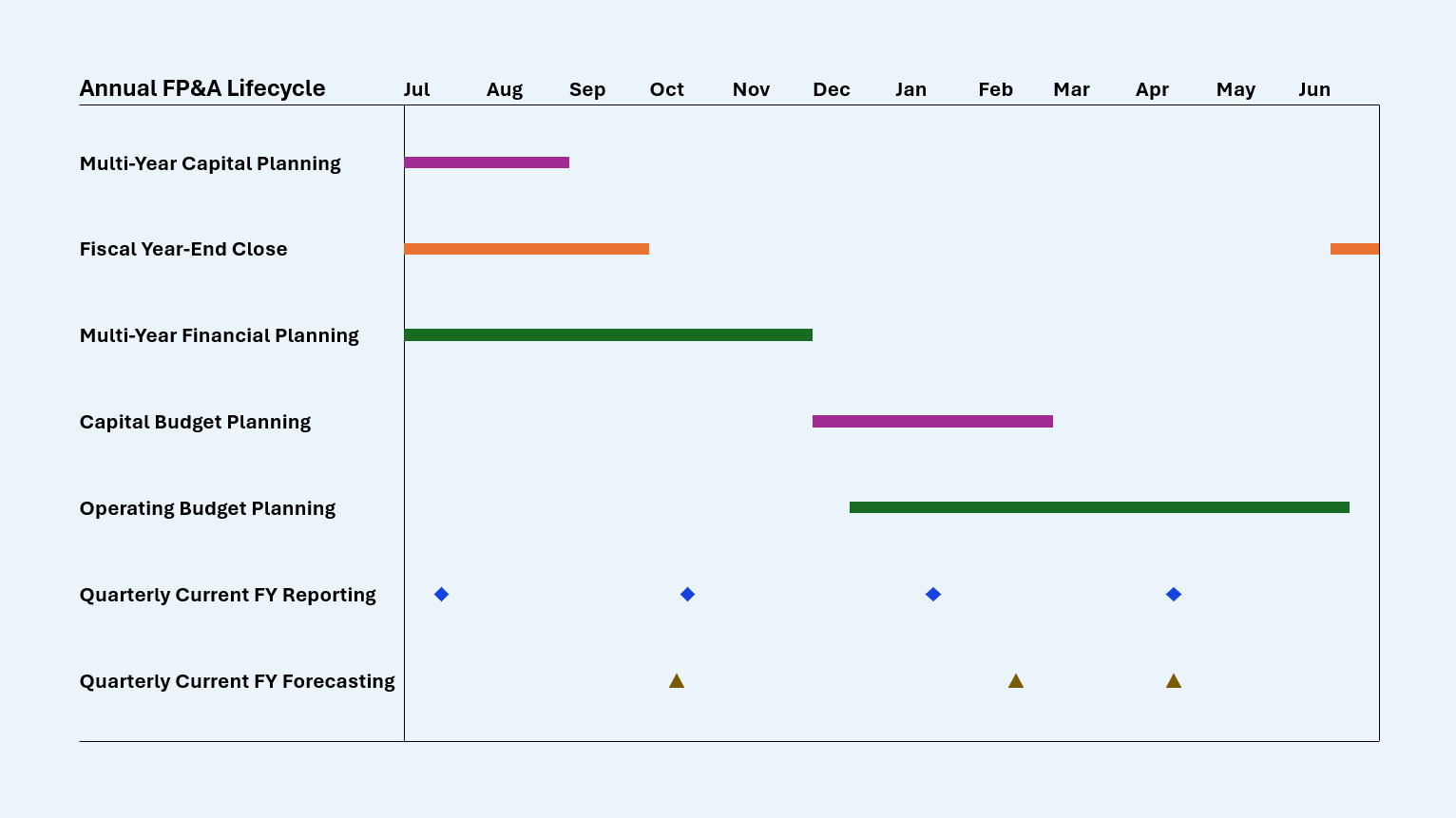
Each deliverable is described in greater detail below.
Multi-Year Capital Plan (MYCP)
Purpose:
- Work closely with Campus Planning and Design and Facilities to update the multi-year view of capital needs and priorities for the school
Key Deliverables:
- Alignment of capital plan with strategic and space priorities
- Capital spending and funding summary for the next five years
- Refreshed list of active and proposed capital projects
- Updated project timing, phasing, and funding sources
Key Stakeholders:
- School and finance leadership
- Office of Financial Strategy and Planning
- Central Administration
Fiscal Year-End Close
Purpose:
Key Deliverables:
- Completion of revenue, expense, and balance sheet results for the prior fiscal year
- Variance analyses related to current budget versus prior year budget and actuals
- Year-end presentation materials for School and University leadership
Key Stakeholders:
- Local unit managers
- School and finance leadership
- Office of Financial Strategy and Planning
- Central Administration
Multi-Year Financial Plan (MYFP)
Purpose:
- Provide a forward-looking projection over the next five years that synthesizes operating, capital, and technology plans
Key Deliverables:
- 5-year projections of revenue, expense, and net results
- Assumptions for enrollment, tuition, fundraising, compensation, and other major drivers
- Scenario analysis where applicable
Key Stakeholders:
- School and finance leadership
- Office of Financial Strategy and Planning
- Central Administration
Capital Budget Planning
Purpose:
- Work with Campus Planning and Design and Facilities to translate the multi-year capital plan into a detailed capital budget for the upcoming fiscal year
Key Deliverables:
- Review of annual capital budget by project and funding source
- Project identification by type (renewal and infrastructure vs. faculty and program)
- Integration of impacts of depreciation and interest expenses into the operating budget
Key Stakeholders:
- School and finance leadership
- Office of Financial Strategy and Planning
- Central Administration
Operating Budget Planning
Purpose:
- Develop a detailed operating budget for the upcoming fiscal year at the school and local unit level
Key Deliverables:
- Construction of baseline unit-level revenue and expense budgets and adjustments as needed
- Consolidation of budget to compare to target and prior year
- Development of a detailed budget narrative using key assumptions
Key Stakeholders:
- Local unit leaders
- School and finance leadership
- Office of Financial Strategy and Planning
- Central Administration
Quarterly Current Fiscal Year Reporting
Purpose:
- Provide unit managers with timely, standardized financial results and accompanying analysis throughout the fiscal year
Key Deliverables:
- Document current year actuals versus budget and prior year actuals for revenue, expense, and staff headcount
- Comment on key drivers and variances where needed
- Track areas of risk and opportunity where applicable
- Share standardized reports with unit leaders for review
Key Stakeholders:
- Local unit leaders
- School and finance leadership
Quarterly Current Fiscal Year Forecasting
Purpose:
- Revise the current fiscal year outlook based on year-to-date performance and updated assumptions
Key Deliverables:
- Updates to full-year forecast versus original budget projection
- Update areas of risk and opportunity and document reason for changes from budget
- Development of mitigation actions and recommended budget adjustments as needed
Key Stakeholders:
- School and finance leadership
- Office of Financial Strategy and Planning